|
 |
 |
 |
 |
 |
 |
 |
 |

 |
Magnetic Needles Turn Somersaults
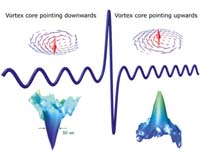
Stuttgart, Germany (SPX) Nov 29, 2006 Scientists at the Max Planck Institute of Metals Research in Stuttgart have discovered a new mechanism with which it is possible to use weak magnetic fields to reverse tiny magnetic structures, called vortex cores, quickly and with no losses. Up until now, very strong magnetic fields have been necessary to accomplish this, requiring highly complex technology. The new method might open up new possibilities for magnetic data storage (Nature, November 23rd, 2006). For about ten years now, tiny magnetic structures measuring a few millionths of a millimetre have met with growing interest from the worlds of science and technology, particularly on account of their potential applications in magnetic storage. A fascinating quantum mechanical phenomenon occurs in these structures: the vortex core, which has been predicted in theory for forty years, but which experiments revealed only four years ago. In small magnetic plates, the magnetised areas often come together to form level closed magnetic circuits - these are the vortices. Imagine walking with an atom-sized compass in a vortex. The compass needle would always be level, unless you approached its centre, the vortex. There the atomic magnetic compass needles rise from the surface and a magnetic field is created over a tiny radius of around 20 atoms, the largest possible in the material. The magnetic needles can point either up or down in the vortex core (fig. 1). However, if this property is to be used for magnetic storage, a way must be found to combat the enormous stability typical of vortex structures. Up to now, very high external magnetic fields of around half a Tesla were required to reverse the vortex core. That is approximately one third of the field that the strongest permanent magnet is capable of delivering. Researchers at the Max Planck Institute of Metals Research have now found an elegant solution which reverses vortex cores much more easily. Using time-resolved magnetic scanning X-ray microscopy, developed by Hermann Stoll's group in Professor Schutz's department at the Institute, they have discovered a previously unknown mechanism - dynamic reversal of the vortex core. A magnetic pulse (see fig. 1) is used to build a magnetic field at right angles to the vortex, so that the whole structure is stimulated to execute a collective spin movement. As micromagnetic simulations show (fig. 2), this creates an opposite magnetisation at the edge of the original vortex, whereby virtually no energy is used. The result is a vortex-antivortex pair. The antivortex cancels out the original vortex which leaves just one vortex with reverse polarisation. In this way, the Max Planck scientists, together with researchers from the University of Ghent, the Advanced Light Source in Berkeley, California, the Julich Research Centre and the Universities of Regensburg and Bielefeld, succeeded in efficiently and deliberately reversing the vortex core with magnetic pulses that were approximately 300 times weaker, but very short. It is possible that this reversal mechanism, which has been observed here for the first time, can be used for a completely new magnetic storage concept. The directions of the small nanoscopic magnetic needles define a digital bit that is extremely stable in the face of frequently unavoidable external factors such as heat or interference from magnetic fields. With the newly discovered dynamic effect, the vortex core is easy to reverse, with no losses and, above all, extremely quickly. The project was supported by the Max Planck Society, the German Research Council through the "Ultrafast Magnetisation Processes" priority programme and by the management of the Office of Science, Office of Basic Energy Science at the US Department of Energy. Community Email This Article Comment On This Article Related Links Max Planck Institute of Metals Research Computer Chip Architecture, Technology and Manufacture Nano Technology News From SpaceMart.com
 Brilliant Growth Without Gold
 Halle, Germany (SPX) Nov 29, 2006
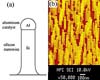
Max Planck researchers in Halle present new methods for manufacturing nanowires from silicon Silicon nanowires can help to further reduce the size of microchips. Scientists at the Max Planck Institute for Microstructure Physics in Halle have for the first time developed single crystal silicon nanowires that fulfil the key criteria to this end. The researchers used aluminium as a catalyst to grow the nanowires. |
|
|

| The content herein, unless otherwise known to be public domain, are Copyright 1995-2006 - SpaceDaily.AFP and UPI Wire Stories are copyright Agence France-Presse and United Press International. ESA PortalReports are copyright European Space Agency. All NASA sourced material is public domain. Additionalcopyrights may apply in whole or part to other bona fide parties. Advertising does not imply endorsement,agreement or approval of any opinions, statements or information provided by SpaceDaily on any Web page published or hosted by SpaceDaily. Privacy Statement |