|
 |
 |
 |
 |
 |
 |
 |
 |

 |
NASA, IMAX Team Up On Hubble Servicing Mission
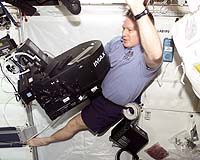
Washington DC (SPX) Oct 02, 2007 Thanks to cooperation between NASA, IMAX Corporation, and Warner Bros. Pictures, the IMAX 3D camera is scheduled for a journey to the Hubble Space Telescope in 2008. The camera will accompany astronauts on mission STS-125 and capture film for a new production that will chronicle the telescope's life story. The film is set for release in early 2010 and marks Warner Bros. Pictures' first venture into space. "We are thrilled that people from around the world will experience this vital servicing mission from a front-row seat," said NASA Deputy Administrator Shana Dale. "Audiences will be mesmerized as they are transported to the distant galaxies of the universe." IMAX's long-standing partnership with NASA has enabled millions of people to travel into space through a series of award-winning films. The IMAX 3D camera made its first space voyage in 2001 for the production of "Space Station 3D." That film took audiences on a virtual tour of the International Space Station. "A decade ago we made a film that briefly touched on the subject of Hubble, but back then its first images were just coming in," said IMAX producer and director Toni Myers. "Today, we have Hubble's entire phenomenal legacy of data to explore. With IMAX 3D, we can transport people to galaxies that are literally 13 billion light years away. Real star travel is here at last." The 3D camera will watch as astronauts work on Hubble during the 11 days of Servicing Mission 4, the last scheduled trip to the telescope. The space shuttle will rendezvous with Hubble on the third day of the flight. Using the shuttle's mechanical arm, the telescope will be placed on a work platform in the cargo bay. Five separate space walks will be needed to accomplish all of the mission objectives, which include installing new instruments and guidance sensors. "Our original IMAX 3D releases have already put audiences in the driver's seat of a NASCAR racecar and taken them swimming with some of the most exotic undersea creatures on earth, and now we look forward to transporting them to the far reaches of the universe," said Dan Fellman, president of Warner Bros. domestic distribution. "Warner Bros. and IMAX have collaborated on 20 films over the last four years, and we are excited to share our next endeavor -- the IMAX 3D space film -- with our audience." Community Email This Article Comment On This Article Related Links Hubble Space Telescope News and Technology at Skynightly.com
 Herschel's Heart And Brain Mated
 Friedrichshafen, Germany (SPX) Sep 20, 2007
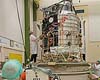
Herschel, Europe's infrared space observatory is being presented to the media in a joint press event by ESA and Astrium in Friedrichshafen, Germany. Two of the satellite's most fundamental modules, its 'heart' and 'brain', have now been mated. The far-infrared space observatory is ESA's latest mission that will study the formation and evolution of stars and galaxies. Herschel will carry the largest telescope ever flown in space, giving astronomers their best view yet of the cold and most distant objects in the universe. |
|
|

| The content herein, unless otherwise known to be public domain, are Copyright 1995-2007 - SpaceDaily.AFP and UPI Wire Stories are copyright Agence France-Presse and United Press International. ESA Portal Reports are copyright European Space Agency. All NASA sourced material is public domain. Additional copyrights may apply in whole or part to other bona fide parties. Advertising does not imply endorsement,agreement or approval of any opinions, statements or information provided by SpaceDaily on any Web page published or hosted by SpaceDaily. Privacy Statement |