|
 |
 |
 |
 |
 |
 |
 |
 |

 |
NASA Gives WISE Decision The Go Ahead
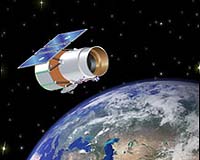
UPI Correspondent Pasadena (UPI) Oct 30, 2006 NASA has approved construction of a satellite that will scan the entire sky in infrared light to detect cool stars and bright galaxies. The Wide-field Infrared Survey Explorer, in its design stage at the University of California-Los Angeles for eight years, is to be launched late in 2009. It will orbit the Earth and operate for at least seven months, with data expected to be broadcast several times daily. Edward Wright, UCLA professor of physics and astronomy, is WISE's principal investigator. NASA's Jet Propulsion Laboratory in Pasadena, Calif., will manage the mission, with JPL's William Irace as project manager, NASA said. WISE will survey the cosmos with infrared detectors 500 times more sensitive than those used in previous survey missions. Wright said that 99 percent of the sky has not been observed yet with this kind of sensitivity, and that the survey should be able to find and observe at least 100 million galaxies and hundreds of nearby cool stars that are currently undetectable. "This mission has incredible power for discovery," Wright said. "I expect that what we find will be amazing. There is still so much we don't know."
Source: United Press International Community Email This Article Comment On This Article Related Links Stellar Chemistry, The Universe And All Within It Stellar Chemistry, The Universe And All Within It
 Latest Views Of The V838 Monocerotis Light Echo From Hubble
 Baltimore MD (SPX) Oct 27, 2006
26-October-2006 Hubble has returned to the intriguing V838 Monocerotis many times since its initial outburst in 2002 to follow the evolution of its light echo. Two new images provide the most astonishing views of V838 to date. |
|
|

| The content herein, unless otherwise known to be public domain, are Copyright 1995-2006 - SpaceDaily.AFP and UPI Wire Stories are copyright Agence France-Presse and United Press International. ESA PortalReports are copyright European Space Agency. All NASA sourced material is public domain. Additionalcopyrights may apply in whole or part to other bona fide parties. Advertising does not imply endorsement,agreement or approval of any opinions, statements or information provided by SpaceDaily on any Web page published or hosted by SpaceDaily. Privacy Statement |