|
 |
 |
 |
 |
 |
 |
 |
 |

 |
Latest Views Of The V838 Monocerotis Light Echo From Hubble
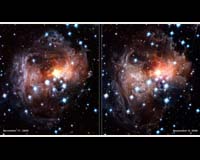
Baltimore MD (SPX) Oct 27, 2006 26-October-2006 Hubble has returned to the intriguing V838 Monocerotis many times since its initial outburst in 2002 to follow the evolution of its light echo. Two new images provide the most astonishing views of V838 to date. The unusual variable star V838 Monocerotis (V838 Mon) continues to puzzle astronomers. This previously unknown star underwent an outburst early in 2002, during which it temporarily increased in brightness to become 600,000 times more luminous than our Sun. Light from this sudden eruption is illuminating the interstellar dust surrounding the star, producing the most spectacular "light echo" in the history of astronomy. As light from the eruption propagates outward into the dust, it is scattered by the dust and travels to the Earth. The scattered light has travelled an extra distance in comparison to light that reaches Earth directly from the stellar outburst. Such a light echo is the optical analogue of the sound echo produced when an Alpine yodel is reflected from the surrounding mountainsides. The NASA/ESA Hubble Space Telescope has been observing the V838 Mon light echo since 2002. Each new observation of the light echo reveals a new and unique "thin-section" through the interstellar dust around the star. This release shows new images of the light echo from the Hubble Advanced Camera for Surveys taken in November 2005 (left) and again in September 2006 (right). The numerous whorls and eddies in the interstellar dust are particularly noticeable. Possibly they have been produced by the effects of magnetic fields in the space between the stars. The Hubble observations have been used to determine the distance to V838 Mon, using a technique based on the polarisation of the reflected light. Hubble has polarising filters that only pass light that vibrates at certain angles. This method yields a distance of 20,000 light-years for V838 Mon, suggesting that, during its outburst, V838 Mon was one of the brightest stars in the entire Milky Way. Although the reason for the eruption is still unclear, some astronomers have suggested it might have resulted from the collision of two stars. Community Email This Article Comment On This Article Related Links Space Telescope Science Institute Stellar Chemistry, The Universe And All Within It Stellar Chemistry, The Universe And All Within It
 Star Ends Infancy Abruptly
 Hilo HI (SPX) Oct 26, 2006
Zooming in on a nearby young star called HD 141569A, astronomers from the National Astronomical Observatory of Japan and the Max Planck Institute for Astronomy used the Subaru telescope on Mauna Kea, Hawai'i, to discover a hole in a disk of gas and dust encircling the star. The existence of this large gap, which is about the size of the orbit of Saturn, supports the theory that this young star ended its infancy abruptly, by ionizing and pushing away the gas in the disk from which it was born. |
|
|

| The content herein, unless otherwise known to be public domain, are Copyright 1995-2006 - SpaceDaily.AFP and UPI Wire Stories are copyright Agence France-Presse and United Press International. ESA PortalReports are copyright European Space Agency. All NASA sourced material is public domain. Additionalcopyrights may apply in whole or part to other bona fide parties. Advertising does not imply endorsement,agreement or approval of any opinions, statements or information provided by SpaceDaily on any Web page published or hosted by SpaceDaily. Privacy Statement |