|
 |
 |
 |
 |
 |
 |
 |
 |

 |
NASA Completes Successful Year Of ELV Launches
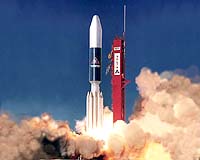
KSC - Dec 11, 2003 A busy year of successful missions is drawing to a close for NASA's Expendable Launch Services. Since January, eight spacecraft have been safely and successfully deployed on expendable launch vehicles (ELVs). Several of these missions had been delayed by NASA ELV engineers so potential problems with vehicles could be thoroughly examined and analyzed before their subsequent launch. "We're proud of the exceptional work done by our ELV team," said NASA's Associate Administrator for Space Flight William Readdy. "Whenever a technical problem cropped up, they were deliberate in their assessment and approach to finding a solution." The planned April 18 launch of the Space InfraRed Telescope Facility (SIRTF), the last of NASA's 'Great Observatories,' was delayed by NASA ELV engineers concerned with a delamination on the nozzle of one of the Delta 7925-H rocket's strap-on solid rocket motors. SIRTF eventually launched August 25 after the motor was replaced. MER-B, the second Mars Rover (after MER-A) was launched July 7 after a delay of nine days allowed for repair of cork insulation on the rocket booster. "2003 has been a banner year for our robotic exploration of the universe," said NASA's Associate Administrator for Space Science Dr. Ed Weiler. "The excitement of missions to Mars and all our other missions begin with a successful launch from Earth." "NASA's expendable launch vehicle program has consistently delivered superb services and unprecedented success in launching our armada of Earth observing satellites," said NASA Associate Administrator for Earth Sciences Dr. Ghassem R. Asrar. "We're confident the NASA team will continue to provide its exemplary leadership and services to the Enterprise." Depending upon the specific needs of a mission, ELVs can be launched from either of two locations: Vandenberg Air Force Base, Calif., or Cape Canaveral Air Force Station, Fla. "The agency has employed a 'mixed fleet' philosophy," said Karen Poniatowski, assistant associate administrator for launch services. "That allows us to purchase launch services as needed using a wide range of vehicles to deploy payloads." Since 1987, when NASA began purchasing launch services, the agency's ELV success rate has been 98.5% (67 of 68 launches successful). Community Email This Article Comment On This Article Related Links Kennedy Space Center SpaceDaily Search SpaceDaily Subscribe To SpaceDaily Express Launch Pad at Space-Travel.com
 Soyuz To Launch Radarsat-2
 Evry, France (SPX) Jan 11, 2006
Starsem announced Monday the signing of a contract with MacDonald, Dettwiler and Associates (MDA) for the launch of MDA's RADARSAT-2 Earth observation satellite by a Soyuz launch vehicle. |
|
|

| The content herein, unless otherwise known to be public domain, are Copyright 1995-2006 - SpaceDaily.AFP and UPI Wire Stories are copyright Agence France-Presse and United Press International. ESA PortalReports are copyright European Space Agency. All NASA sourced material is public domain. Additionalcopyrights may apply in whole or part to other bona fide parties. Advertising does not imply endorsement,agreement or approval of any opinions, statements or information provided by SpaceDaily on any Web page published or hosted by SpaceDaily. Privacy Statement |