|
 |
 |
 |
 |
 |
 |
 |
 |

 |
NASA Awards Space Station Water Contract To Hamilton Sundstrand
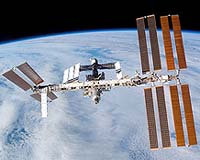
Washington DC (SPX) Apr 16, 2008 NASA has awarded a sole-source contract to Hamilton Sundstrand Space Systems International for water production services aboard the International Space Station. The firm fixed-price contract has a potential value of $65 million and extends through Sept. 30, 2014. Hamilton Sundstrand will provide equipment that uses the station's excess carbon dioxide and hydrogen to produce water and methane. The methane will be vented into space, and the water will be fed into the station's waste water system, where it will undergo treatment before it is used. Under the contract, NASA will not buy hardware, but instead will purchase the water service. If the system does not work, NASA will not pay for it. "This is a fundamental shift in the way we do business," said Bill Gerstenmaier, NASA associate administrator for Space Operations. "In the business arrangement we have negotiated for water production services, the contractor is responsible for all system development and performance. The only requirements we have imposed are those associated with safety and interfaces. This provides a procurement and technology test bed for future exploration systems, which need to operate in an environment far from Earth, where routine resupply is not feasible." The equipment employs a chemical process known as a Sabatier reaction. The process is named for French Nobel laureate and chemist Paul Sabatier, who discovered that hydrogen and carbon dioxide produce methane and water at elevated temperatures and pressures. The Hamilton Sundstrand-provided hardware will be flown during shuttle mission STS-130, which is targeted for launch in late 2009. A checkout of the system is planned for May 2010. Hamilton Sundstrand will retain title to the hardware and ensure it meets NASA's space station safety and interface requirements. Water is used on the space station for a variety of purposes, including drinking, food preparation, oxygen generation, electronic equipment cooling and hygiene. About half of the station's water needs are obtained through recycling. The rest of its water currently is transported by the space shuttle or supply ships, including the Russian Progress and European Automated Transfer Vehicle. "We are very excited to provide this service to NASA," said Ed Francis, Hamilton Sundstrand Space, Land and Sea vice president and general manager. "Our experience providing environmental control and life support systems and other hardware for the space station gives us the insight needed to recognize areas we can help NASA. This is a great example of how NASA and industry can work together to benefit both." Hamilton Sundstrand provides a number of systems for the space station, including those that control electrical power and process water, waste and air. The company has been the prime contractor to NASA for astronaut spacesuits since 1981. Community Email This Article Comment On This Article Related Links International Space Station Station at NASA Station and More at Roscosmos S.P. Korolev RSC Energia Watch NASA TV via Space.TV Space Station News at Space-Travel.Com
 Russia Needs Billions More To Complete It's ISS Segment
 Moscow (RIA Novosti) Apr 14, 2008
Russia will need an additional $5 billion to finish the construction of its segment of the International Space Station (ISS) by 2015, the head of Russia's rocket and space corporation Energia said Friday. The ISS is a joint project of space agencies from the United States, Russia, Europe, Canada and Japan. The orbital station is likely to remain operational until 2020. |
|
|

| The content herein, unless otherwise known to be public domain, are Copyright 1995-2007 - SpaceDaily.AFP and UPI Wire Stories are copyright Agence France-Presse and United Press International. ESA Portal Reports are copyright European Space Agency. All NASA sourced material is public domain. Additional copyrights may apply in whole or part to other bona fide parties. Advertising does not imply endorsement,agreement or approval of any opinions, statements or information provided by SpaceDaily on any Web page published or hosted by SpaceDaily. Privacy Statement |