|
 |
 |
 |
 |
 |
 |
 |
 |

 |
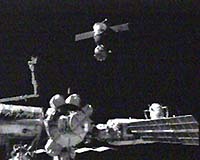
Russia Needs Billions More To Complete It's ISS Segment
Moscow (RIA Novosti) Apr 14, 2008 Russia will need an additional $5 billion to finish the construction of its segment of the International Space Station (ISS) by 2015, the head of Russia's rocket and space corporation Energia said Friday. The ISS is a joint project of space agencies from the United States, Russia, Europe, Canada and Japan. The orbital station is likely to remain operational until 2020. "So far, we have allocated about $4.2 billion for the ISS project, but we will need an additional $5 billion to finish the construction [of the Russian segment] by 2015," Energia President Vitaly Lopota said at a conference dedicated to Cosmonautics Day, celebrated in Russia on April 12. The first ISS element, the Russian Zarya module, was put into orbit in November 1998. Several modules have been attached to the structure since then, but ongoing construction has missed the initial deadline, largely due to delays in U.S. shuttle launches and a lack of financing. The Russian segment of the orbital station should have 10 modules by 2015, the Energia official said. Russia is planning to launch two small research modules to the ISS in 2009-2010, a multi-purpose laboratory module - in 2011, and two energy modules - in 2014-2015. The ISS crew will comprise six members, including three Russian cosmonauts, starting from 2009, Lopota said.
Source: RIA Novosti Community Email This Article Comment On This Article Related Links Station at NASA Station and More at Roscosmos S.P. Korolev RSC Energia Watch NASA TV via Space.TV Space Station News at Space-Travel.Com
 Russia to call for extending ISS use
 Moscow (AFP) April 11, 2008
Russia will ask its foreign partners in June to extend the exploitation of the International Space Station (ISS) until 2020 as the station's Russian segment would take longer to complete, Russian space officials said. |
|
|

| The content herein, unless otherwise known to be public domain, are Copyright 1995-2007 - SpaceDaily.AFP and UPI Wire Stories are copyright Agence France-Presse and United Press International. ESA Portal Reports are copyright European Space Agency. All NASA sourced material is public domain. Additional copyrights may apply in whole or part to other bona fide parties. Advertising does not imply endorsement,agreement or approval of any opinions, statements or information provided by SpaceDaily on any Web page published or hosted by SpaceDaily. Privacy Statement |