|
 |
 |
 |
 |
 |
 |
 |
 |

 |
Mute Swan Population Helps Explain Longstanding Evolutionary Question
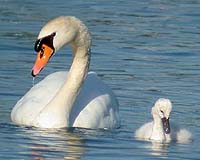
Oxford, England (SPX) Jan 25, 2006 In an important new study forthcoming from The American Naturalist, biologists from the University of Oxford tracked a colony of mute swans for more than two decades to explore a longstanding evolutionary question: whether the number of eggs laid by a female bird � known as "clutch size" � changes in accordance with natural selection. "Extensive debate in the literature was first focused on the question: Why does a population's average clutch size differ from the most productive clutch size?" said researcher Ann Charmantier. "Gradually the debate switched to an evolutionary point of view with a second, related question: Why is clutch size not evolving despite significant heritability and directional selection?" Many long-term studies of avian clutch size have looked for, but not seen, an increase in the number of eggs laid. However, this 25-year study of the selection, inheritance, and evolution in the mute swan population of Abbotsbury, England, yielded data on clutch size consistent with the direction predicted by evolutionary theory. "In this study population, clutch size shows a clear response to selection, providing us with a clear illustration of microevolutionary process on a small timescale," explain the researchers. The researchers hypothesize that a recent relaxation of food constraints and an increase in protection from predators may have helped enable the swans to evolve towards a new, larger clutch size. Community Email This Article Comment On This Article Related Links The American Naturalist University of Oxford Darwin Today At TerraDaily.com
 Increased Competition For Pollen May Lead To Plant Extinctions
 Santa Barbara CA (SPX) Jan 24, 2006
The decline of birds, bees and other pollinators in the world's most diverse ecosystems may be putting plants in those areas at risk, according to new research. The finding raises concern that more may have to be done to protect Earth's most biologically rich areas, scientists say in an article appearing in the Jan. 17 issue of the Proceedings of the National Academy of Sciences (PNAS). |
|
|

| The content herein, unless otherwise known to be public domain, are Copyright 1995-2006 - SpaceDaily.AFP and UPI Wire Stories are copyright Agence France-Presse and United Press International. ESA PortalReports are copyright European Space Agency. All NASA sourced material is public domain. Additionalcopyrights may apply in whole or part to other bona fide parties. Advertising does not imply endorsement,agreement or approval of any opinions, statements or information provided by SpaceDaily on any Web page published or hosted by SpaceDaily. Privacy Statement |