|
 |
 |
 |
 |
 |
 |
 |
 |

 |
Moon Shadows
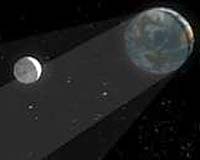
Moffett Field CA (SPX) Oct 27, 2004 Skywatchers are about to be treated to a total lunar eclipse, just in time for Halloween. For more than an hour Wednesday night, the Earth's shadow will completely cover the moon - making it glow orange like a pumpkin. The color comes from Earth's sunrises and sunsets. That's the only light hitting the full moon during the eclipse, when the Earth passes directly between the sun and moon. Prime viewing time will be late-night in North and South America, and pre-dawn Thursday in Europe and western Africa. This is the last such eclipse until March 2007. Total eclipses of the moon occur when the moon passes through the circular shadow that the Earth casts into space and is fully shaded from direct sunlight. Although masked by the Earth completely or partially from the Sun for as much as an hour and a half, scattering of sunlight off the limbs of our atmosphere doesn't leave the moon without illumination. Instead the blood-bright color of long-wavelength red light enshrouds the moon's otherwise familiar grey pallor. The eerie, coppery hue is produced by sunlight filtered, reddened and scattered by the rim of the Earth's atmosphere. Because of changes in terrestrial dust in the atmosphere, each lunar eclipse is unique in appearance. The Moon is believed to play an important role in Earth's habitability . Because the Moon helps stabilize the tilt of the Earth's rotation, it prevents the Earth from wobbling between climatic extremes. Without the Moon, seasonal shifts would likely outpace even the most adaptable forms of life. In addition, because our moon is lifeless, it is one of the most appealing places to look for the preserved records of life elsewhere. At least according to recent estimates for the amount of ejected rocks that might survive there, the Moon may hold clues from the early history of Mars, Venus and Earth. Community Email This Article Comment On This Article Related Links SpaceDaily Search SpaceDaily Subscribe To SpaceDaily Express Mars News and Information at MarsDaily.com Lunar Dreams and more
 SMART 1 Uses New Imaging Technique In Lunar Orbit
 Paris, France (ESA) Dec 28, 2005
ESA's SMART-1 spacecraft has been surveying the Moon's surface in visible and near-infrared light using a new technique, never before tried in lunar orbit. |
|
|

| The content herein, unless otherwise known to be public domain, are Copyright 1995-2006 - SpaceDaily.AFP and UPI Wire Stories are copyright Agence France-Presse and United Press International. ESA PortalReports are copyright European Space Agency. All NASA sourced material is public domain. Additionalcopyrights may apply in whole or part to other bona fide parties. Advertising does not imply endorsement,agreement or approval of any opinions, statements or information provided by SpaceDaily on any Web page published or hosted by SpaceDaily. Privacy Statement |