|
 |
 |
 |
 |
 |
 |
 |
 |

 |
MetOp Gets A Go For July 17 Launch
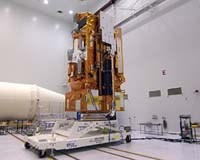
Baikonur Cosmodrome, Kazakhstan (SPX) Jun 28, 2006 MetOp-A has successfully completed the first phase of its testing at Baikonur, confirming the launch date of the first European polar-orbiting satellite dedicated to operational meteorology for July 17, ESA announced Tuesday. MetOp-A - jointly established by ESA and the European Organization for the Exploitation of Meteorological Satellites - promises to provide data of unprecedented accuracy and resolution on a host of different variables such as temperature and humidity, wind speed and direction, ozone and other trace gases, ESA said in a news release. Since the arrival of MetOp-A at its launch site in Baikonur on April 18, the Service Module, Payload Module and Solar Array, which were shipped as individual items, have been integrated and tested. Following a review of the satellite status and results of the testing to date, together with the outputs of EUMETSAT's review of the readiness of the ground segment, launcher and overall system, EUMETSAT and ESA authorized EADS Astrium on June 17 to commence MetOp-A's fueling activities, marking a milestone in the EUMETSAT Polar System program. Following completion of the MetOp-A fueling, engineers will integrate the satellite with the Fregat upper stage before encapsulating it in the rocket fairing. The resulting upper composite then will be integrated with the Soyuz launcher and the complete system is scheduled to be rolled out to the launch pad July 14. The MetOp program, which consists of three satellites to be flown sequentially to ensure the delivery of continuous data until at least 2020, forms the space segment of the EPS program and represents the European contribution to a new cooperative venture with the U.S. National Oceanic and Atmospheric Administration. Until MetOp-A launches, meteorological data from polar-orbiting satellites has had to be procured from NOAA weather satellites. After the launch, responsibilities for meteorological satellite services will be shared between Europe and the United States. MetOp-A is designed to work in conjunction with NOAA through the Initial Joint Polar Satellite System, a cooperative venture between EUMETSAT and NOAA. MetOp-A will replace the NOAA morning-orbit service, while another NOAA satellite occupies the afternoon shift. The two satellites will fly in complementary orbits, thus offering maximum coverage. This global observing system will be able to provide invaluable meteorological data from polar orbit to users within two hours and 15 minutes of the measurements being taken, ESA said in the release. MetOp-A is equipped with a set of new-generation European instruments that offer advanced remote sensing capabilities to both meteorologists and climatologists along with a set of heritage instruments provided by NOAA and CNES, the French Space Agency. In addition to its meteorological observations and climate monitoring objectives, MetOp-A will contribute to other missions, such as research and rescue and the monitoring of charged particles present in the orbital environment near Earth. MetOp-A was developed by a consortium of European companies led by EADS-Astrium as the main contractor. Community Email This Article Comment On This Article Related Links ESA Weather News at TerraDaily.com
 Rockwell Collins Introduces Next Gen Of Weather Radar
 Cedar Rapids IO (SPX) Jun 28, 2006
Rockwell Collins has announced its next generation of weather radar, the MultiScan Hazard Detection system, which will enable airlines safer, smoother and more efficient flights. "We're introducing new features that offer an innovative approach to detecting, assessing and displaying weather hazards," said Kelly Ortberg, vice president and general manager, Air Transport Systems for Rockwell Collins. |
|
|

| The content herein, unless otherwise known to be public domain, are Copyright 1995-2006 - SpaceDaily.AFP and UPI Wire Stories are copyright Agence France-Presse and United Press International. ESA PortalReports are copyright European Space Agency. All NASA sourced material is public domain. Additionalcopyrights may apply in whole or part to other bona fide parties. Advertising does not imply endorsement,agreement or approval of any opinions, statements or information provided by SpaceDaily on any Web page published or hosted by SpaceDaily. Privacy Statement |