Energy News  
Message From Mercury Safely Down To Earth

Desktops - 1360x768 or 1280x1024 or 1024x768

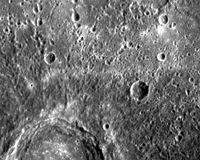
The image shows part of a large, fresh crater with secondary crater chains located near Mercury's equator on the side of the planet newly imaged by MESSENGER. Large, flat-floored craters often have terraced rims from post-impact collapse of their newly formed walls. The hundreds of secondary impactors that are excavated from the planet's surface by the incoming object create long, linear crater chains radial to the main crater. These chains, in addition to the rest of the ejecta blanket, create the complicated, hilly terrain surrounding the primary crater. By counting craters on the ejecta blanket that have formed since the impact event, the age of the crater can be estimated. This count can then be compared with a similar count for the crater floor to determine whether any material has partially filled the crater since its formation. With their large size and production of abundant secondary craters, these flat-floored craters both illuminate and confound the study of the geological history of Mercury. Credit: NASA/Johns Hopkins University Applied Physics Laboratory/Carnegie Institution of Washington
by Staff Writers
Laurel MD (SPX) Jan 19, 2008
A day after its successful flyby of Mercury, the Messenger spacecraft turned toward Earth on Tuesday and began downloading the 500 megabytes of data that had been stored on the solid-state recorder during the encounter.

All of those data, including 1,213 images from the Mercury Dual Imaging System (MDIS) cameras, have now been received by the Science Operations Center at the Johns Hopkins University Applied Physics Laboratory in Laurel, Md.

Preliminary analysis of these data by the Messenger Science Team has confirmed that all seven Messenger instruments are healthy and operated as planned during the flyby.

As Messenger flew by the planet, it missed its targeted aim point by only 8.25 kilometers (5.12 miles), affording the critical gravity assist needed to continue on a course to become - in 2011 - the first spacecraft ever to orbit Mercury.

During this first encounter, the payload successfully conducted a carefully orchestrated sequence of observations designed to take full advantage of the geometry of the flyby trajectory and to optimize the science return from each instrument.

In addition to images of the previously unseen portion of the planet's surface, measurements were made that will contribute to the characterization of all aspects of Mercury and its environment, from its metallic core to the far reaches of its magnetosphere.

"We have one excited Science Team," says Messenger Project Manager, Peter D. Bedini, of APL, "and their enthusiasm is contagious."

The analysis of these data is just beginning, but there are already indications that new discoveries are at hand.


Community
Email This Article
Comment On This Article

Related Links
Messenger at APL
News Flash at Mercury
Mars News and Information at MarsDaily.com
Lunar Dreams and more


Memory Foam Mattress Review
Newsletters :: SpaceDaily :: SpaceWar :: TerraDaily :: Energy Daily
XML Feeds :: Space News :: Earth News :: War News :: Solar Energy News


European-Japanese mission to Mercury clears key hurdle
Paris (AFP) Jan 18, 2008
The European Space Agency on Friday gave the official kickoff to a billion-dollar project with Japan to send two unmanned scouts to Mercury by signing a construction contract with satellite maker Astrium.


  • India to stand up to Brown on climate change
  • Bush officials say oil drilling will not harm polar bears
  • US Has An Ally In Azerbaijan For Energy Supply
  • Analysis: Russia eyes Caspian projects

  • Sarkozy seeks nuclear, defence deals during India visit
  • Russia delivers more than half nuclear fuel to Iran: official
  • Taiwan may ship nuclear waste to France: report
  • Russia, Bulgaria sign 4.0-bln-euro nuclear plant contract

  • New Model Revises Estimates Of Terrestrial Carbon Dioxide Uptake
  • A Breathable Earth
  • Researchers Find Origin Of Breathable Atmosphere Half A Billion Years Ago
  • Study Reveals Lakes A Major Source Of Prehistoric Methane

  • China to plant 2.5 billion trees: report
  • Rwanda's Gishwati Forest Selected As Site For Historic Conservation Project
  • PM pledges one billion dollars for struggling mining, forestry towns
  • No Convincing Evidence For Decline In Tropical Forests

  • German farmers cultivate ways to fight global warming
  • WWF cries 'scandal' over French plans for fish quotas
  • FDA OKs food from some cloned animals
  • Micro-Grant Makes Business Boom For Iraqi Butcher

  • Green car sales soar 49 percent in Sweden: agency
  • Renault to offer a 'green' Dacia Logan by 2010: report
  • Germans, Japanese automakers push diesel in the US
  • Green-car market battle lines drawn at Detroit Motor Show

  • Qatar Airways looking to natural gas fuel
  • EADS offers to build military, civilian aircraft in US
  • Purdue Wind Tunnel Key For Hypersonic Vehicles And Future Space Planes
  • Antarctic ballooning hits milestone

  • Nuclear Power In Space - Part 2
  • Outside View: Nuclear future in space
  • Nuclear Power In Space

  • The content herein, unless otherwise known to be public domain, are Copyright 1995-2007 - SpaceDaily.AFP and UPI Wire Stories are copyright Agence France-Presse and United Press International. ESA Portal Reports are copyright European Space Agency. All NASA sourced material is public domain. Additional copyrights may apply in whole or part to other bona fide parties. Advertising does not imply endorsement,agreement or approval of any opinions, statements or information provided by SpaceDaily on any Web page published or hosted by SpaceDaily. Privacy Statement