|
 |
 |
 |
 |
 |
 |
 |
 |

 |
European-Japanese mission to Mercury clears key hurdle
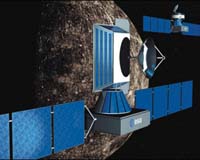
Paris (AFP) Jan 18, 2008 The European Space Agency on Friday gave the official kickoff to a billion-dollar project with Japan to send two unmanned scouts to Mercury by signing a construction contract with satellite maker Astrium. The mission, named BepiColombo, was named by ESA in 2000 as one of its "cornerstone missions" for the new millennium. Launch is scheduled for August 2013, but it will take six years for the two craft to reach the innermost planet of the Solar System. BepiColombo is a joint programme, under ESA leadership, with the Japanese Aerospace Exploration Agency (JAXA). ESA's spacecraft, the Mercury Planetary Orbiter (MPO), will carry 11 instruments to study the planet's surface and internal composition. JAXA's Mercury Magnetospheric Orbiter (MMO) will bear five instruments to study Mercury's magnetosphere, the area of space around the planet that is dominated by its magnetic field. The overall cost of BepiColombo to ESA is 665 million euros (970 million dollars), including launch and operations up to 2020, ESA said in a press release. The contract with Astrium is worth 350.9 million euros, covering the cost of designing and building the MPO and a module that will jointly take the two spacecraft to their destination. The European firm will be in charge of a constellation of subcontractors. A solid, or "rocky" planet, Mercury is pitted with impact craters. Famously, one side of it scorches, while the other side is in deep chill. Most information about Mercury comes from three flybys by the US space probe Mariner 10 in the 1970s. On Monday, a NASA craft, Messenger, skimmed over Mercury at a height of just 200 kilometers (125 miles) to take close-up pictures. It will return in October 2008 and September 2009, and finally in 2011 when it will go into orbit for a year-long study of the planet. "Mercury is the planet closest to the Sun, making it hard to get to, and so it is a technical challenge by anyone's measure," said ESA's director of science, David Southwood. "However, Mercury has also regularly confounded planetary scientists with its exceptional properties and that makes it a grand scientific challenge." The MMO-MPO tandem will be launched from the European Spaceport in Kourou, French Guiana, onboard a Russian-made Soyuz-Fregat 2-1B. The mission derives its name from Giuseppe (Bepi) Colombo, a 20th-century Italian astronomer who shed light on Mercury's orbit. Community Email This Article Comment On This Article Related Links News Flash at Mercury Mars News and Information at MarsDaily.com Lunar Dreams and more
 MESSENGER Reveals Mercury's Geological History
 Baltimore MD (SPX) Jan 18, 2008
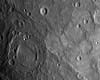
Shortly following MESSENGER's closest approach to Mercury on January 14, 2008, the spacecraft's Narrow Angle Camera (NAC) on the Mercury Dual Imaging System (MDIS) instrument acquired this image as part of a mosaic that covers much of the sunlit portion of the hemisphere not viewed by Mariner 10. Images such as this one can be read in terms of a sequence of geological events and provide insight into the relative timing of processes that have acted on Mercury's surface in the past. |
|
|

| The content herein, unless otherwise known to be public domain, are Copyright 1995-2007 - SpaceDaily.AFP and UPI Wire Stories are copyright Agence France-Presse and United Press International. ESA Portal Reports are copyright European Space Agency. All NASA sourced material is public domain. Additional copyrights may apply in whole or part to other bona fide parties. Advertising does not imply endorsement,agreement or approval of any opinions, statements or information provided by SpaceDaily on any Web page published or hosted by SpaceDaily. Privacy Statement |