|
 |
 |
 |
 |
 |
 |
 |
 |

 |
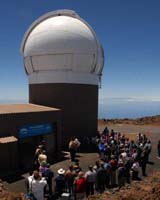
Meetings On Three Islands To Discuss Telescope Replacement
Manoa HI (SPX) Jan 15, 2007 Replacing a University of Hawaii telescope atop Mauna Kea with one that can spot Earth-threatening asteroids and comets is the subject of public meetings slated to take place January 23-31, 2007, on Hawaii, Maui and Oahu. The Hawaii island meetings will take place at Kealakehe Intermediate School Cafeteria on Tuesday, January 23, 2007, in Waimea Civic Center on Wednesday, January 24, 2007, and at the University of Hawaii at Hilo Campus Center on Thursday, January 25, 2007. Doors will open at 5:30 p.m., and the meetings will begin at 6:00 p.m. Placing the telescope atop Maui's Haleakala is an alternative. As a result, a public meeting will take place at Maui's Cameron Center on Tuesday, January 30, 2007. On Oahu, there will also be a meeting at the University of Hawaii at Manoa's Center for Hawaiian Studies Kamakakuokalani Building on Wednesday, January 31, 2007. Doors will open at 5:30 p.m., and the meetings will begin at 6:00 p.m. Each meeting will feature a presentation on the proposed telescope, with people having the opportunity to ask questions, and express opinions and comments. Questions, comments, issues and concerns will be documented and explored as part of a formal environmental process. If Mauna Kea becomes the approved location, the new telescope will replace the 88-inch telescope that has been operated by the University of Hawaii since 1970. The new telescope is atypical in that it will consist of four optical segments, each with its own digital camera. Working together as a system, it will be able to survey the visible sky once each week, finding and tracking asteroids and comets whose paths pass close enough to Earth to pose a danger of collision. The system can help NASA achieve a goal of categorizing near-Earth objects larger than 140 meters in diameter (about 460 feet). Called the Panoramic Survey Telescope And Rapid Response System, or Pan-STARRS, the proposed project will be owned, operated and maintained by the University of Hawaii's Institute for Astronomy. Funding for the project's construction is through a cooperative agreement that is being administered by the United States Air Force Research Laboratory. The University of Hawaii will provide continued funding for maintaining and operating Pan-STARRS. The university will also be responsible for processing the imagery and data. These public meetings are part of a formal review process that investigates potential environmental impacts. Community Email This Article Comment On This Article Related Links Environmental Impact Statement Preparation Notice (EISPN) EIS for PanSTARRS Information on Pan-STARRS Stellar Chemistry, The Universe And All Within It Space Telescope News and Technology at Skynightly.com
 Ball Aerospace/NASA Achieve Key Technology Milestone For James Webb Space Telescope
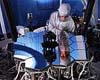 Boulder CO (SPX) Jan 15, 2007
A team of engineers from Ball Aerospace and Technologies Corp. and NASA have successfully met the criteria needed to demonstrate Technology Readiness Level 6 (TRL-6) for the Wavefront Sensing and Control for the James Webb Space Telescope, a measure used by NASA to assess the maturity of evolving technologies. |
|
|

| The content herein, unless otherwise known to be public domain, are Copyright 1995-2006 - SpaceDaily.AFP and UPI Wire Stories are copyright Agence France-Presse and United Press International. ESA PortalReports are copyright European Space Agency. All NASA sourced material is public domain. Additionalcopyrights may apply in whole or part to other bona fide parties. Advertising does not imply endorsement,agreement or approval of any opinions, statements or information provided by SpaceDaily on any Web page published or hosted by SpaceDaily. Privacy Statement |