|
 |
 |
 |
 |
 |
 |
 |
 |

 |
Mechanical Motion Used To 'Spin' Atoms In A Gas
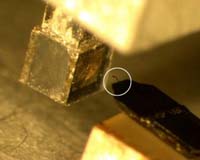
Washington DC (SPX) Jan 04, 2007 For the first time, mechanical motion has been used to make atoms in a gas "spin," scientists at the National Institute of Standards and Technology (NIST) report. The technique eventually might be used in high-performance magnetic sensors, enable power-efficient chip-scale atomic devices such as clocks, or serve as components for manipulating bits of information in quantum computers. As described in the Dec. 1 issue of Physical Review Letters,* the NIST team used a vibrating microscale cantilever, a tiny plank anchored at one end like a diving board, to drive magnetic oscillations in rubidium atoms. The scientists attached a tiny magnetic particle-about 10 by 50 by 100 micrometers in size-to the cantilever tip and applied electrical signals at the cantilever's "resonant" frequency to make the tip of the cantilever, and hence the magnetic particle, vibrate up and down. The vibrating particle in turn generated an oscillating magnetic field that impinged on atoms confined inside a 1-square-millimeter container nearby. The electrons in the atoms, acting like tiny bar magnets with north and south poles, responded by rotating about a static magnetic field applied to the experimental set-up, causing the atoms to rotate like spinning tops that are wobbling slightly. The scientists detected the rotation by monitoring patterns in the amount of infrared laser light absorbed by the spinning atoms as their orientation fluctuated with the magnetic gyrations. Atoms absorb polarized light depending on their orientation with respect to the light beam. Micro-cantilevers are a focus of intensive research in part because they can be operated with low power, such as from a battery, and yet are sensitive enough to detect very slight changes in magnetic fields with high spatial resolution. The NIST team noted that coupling between cantilever motion and atomic spins is easy to detect, and that the atoms maintain consistent rotation patterns for a sufficiently long time, on the order of milliseconds, to be useful in precision applications. For instance, by comparing the oscillation frequency of the cantilever to the natural rotation behavior of the atoms (determined by measuring the extent of the wobble), the local magnetic field can be determined with high precision. Or, arrays of magnetic cantilevers might be constructed, with each cantilever coupled vibrationally to the others and coupled magnetically to a unique collection of atoms. Such a device could be used to store or manipulate binary data in a quantum computer. In theory, the coupling process also could work backwards, so that atomic spins could be detected by monitoring the vibrational motion of the cantilevers. Y-J. Wang, M. Eardley, S. Knappe, J. Moreland, L. Hollberg, and J. Kitching. 2006. Magnetic resonance in an atomic vapor excited by a mechanical resonator. Physical Review Letters. Dec. 1. Community Email This Article Comment On This Article Related Links National Institute of Standards and Technology (NIST) Civil Nuclear Energy Science, Technology and News Powering The World in the 21st Century at Energy-Daily.com The Economy Global Trade News The latest information about the Commercial Satellite Industry Understanding Time and Space
 Astrophysicist Herbert Gursky dies
 Washington (UPI) Dec 18, 2006
 Astrophysicist Herbert Gursky, superintendent of the U.S. Naval Research Laboratory's Space Science Division, died early this month in Fairfax, Va. |
|
|

| The content herein, unless otherwise known to be public domain, are Copyright 1995-2006 - SpaceDaily.AFP and UPI Wire Stories are copyright Agence France-Presse and United Press International. ESA PortalReports are copyright European Space Agency. All NASA sourced material is public domain. Additionalcopyrights may apply in whole or part to other bona fide parties. Advertising does not imply endorsement,agreement or approval of any opinions, statements or information provided by SpaceDaily on any Web page published or hosted by SpaceDaily. Privacy Statement |