|
 |
 |
 |
 |
 |
 |
 |
 |

 |
Martian Meteorite Measurements Give Information On Planet Evolution
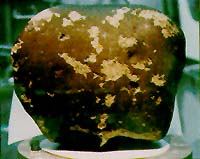
New Haven CT (SPX) Oct 26, 2004 Scientists in the department of Geology and Geophysics at Yale University have devised a method to precisely date the timing and temperature of a meteorite impact on Mars that led to ejection of a piece of the planet into space and its eventual impact on Earth. Meteorites are the main source of mass exchange between planets and carry with them characteristic clues about the nature and history of the planets or planetesimals where they originated, the impacts that dislodged them, and the time they spent in space. Kyoungwon Kyle Min, postdoctoral fellow in geology, reported an innovation for determining the timing and temperatures of ancient impacts that liberate meteorites from extraterrestrial bodies such as Mars. To measure both the age and thermal history of the piece of Martian rock, Min assayed the natural radioactive decay of uranium and thorium to the gas helium in these meteorites, and combined it with knowledge of how temperature affects helium loss over time. This (U-Th)/He dating method, used on single grains of minerals in the "Los Angeles" Martian meteorite gave a far more accurate picture than the conventional method of analyzing chunks of meteorite. The "helium age" of about three million years corresponds with the estimated cosmogenic space exposure age. According to co-author Assistant Professor Peter W. Reiners, "The three million-year age of this meteorite is also important because other meteorites we're working on, including some Martian ones, are several hundred million to billions of years older. These methods allow us to better understand both the timing and dynamics of ancient impacts on other planets, and how these events relate to interplanetary material transfer." Scientists have long looked at meteorites to answer the question of whether there is now, or once was, life on Mars. They now can compare data from meteorites with the observations of space vehicles to learn more about past activities on the surface of Mars. Stefan Nicolescu and James Greenwood from Yale University co-authored the study supported by a grant from the National Science Foundation. Community Email This Article Comment On This Article Related Links Yale University SpaceDaily Search SpaceDaily Subscribe To SpaceDaily Express Mars News and Information at MarsDaily.com Lunar Dreams and more
 Spirit Heading To 'Home Plate'
 Pasadena CA (JPL) Jan 09, 2006
Last week Spirit completed robotic-arm work on "El Dorado." The rover used all three of its spectrometers plus the microscopic imager for readings over the New Year's weekend. |
|
|

| The content herein, unless otherwise known to be public domain, are Copyright 1995-2006 - SpaceDaily.AFP and UPI Wire Stories are copyright Agence France-Presse and United Press International. ESA PortalReports are copyright European Space Agency. All NASA sourced material is public domain. Additionalcopyrights may apply in whole or part to other bona fide parties. Advertising does not imply endorsement,agreement or approval of any opinions, statements or information provided by SpaceDaily on any Web page published or hosted by SpaceDaily. Privacy Statement |