|
 |
 |
 |
 |
 |
 |
 |
 |

 |
Mars And Venus Are Surprisingly Similar
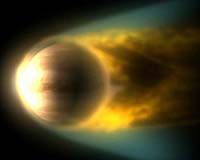
Paris, France (ESA) Mar 06, 2008 Using two ESA spacecraft, planetary scientists are watching the atmospheres of Mars and Venus being stripped away into space. The simultaneous observations by Mars Express and Venus Express give scientists the data they need to investigate the evolution of the two planets' atmospheres. Scientists call this work comparative planetology. Mars Express and Venus Express are so good at it because they carry very similar science instruments. In the case of the Analyser of Space Plasmas and Energetic Atoms (ASPERA), they are virtually identical. This allows scientists to make direct comparisons between the two planets. The new results probe directly into the magnetic regions behind the planets, which are the predominant channels through which electrically-charged particles escape. They also present the first detection of whole atoms escaping from the atmosphere of Venus, and show that the rate of escape rose by ten times on Mars when a solar storm struck in December 2006. By observing the current rates of loss of the two atmospheres, planetary scientists hope that they will be able to turn back the clock and understand what they were like in the past. The results can potentially help understand the evolution of planetary climates. Community Email This Article Comment On This Article Related Links Mars News and Information at MarsDaily.com Lunar Dreams and more
 Mars Express One Of Three Orbiters Preparing For Phoenix Landing
 Paris, France (ESA) Feb 29, 2008
A trio of NASA and ESA spacecraft orbiting Mars are preparing for the 25 May arrival of NASA's Phoenix lander. ESA's Mars Express has already started adjusting its orbit to provide critical back-up monitoring of Phoenix. |
|
|

| The content herein, unless otherwise known to be public domain, are Copyright 1995-2007 - SpaceDaily.AFP and UPI Wire Stories are copyright Agence France-Presse and United Press International. ESA Portal Reports are copyright European Space Agency. All NASA sourced material is public domain. Additional copyrights may apply in whole or part to other bona fide parties. Advertising does not imply endorsement,agreement or approval of any opinions, statements or information provided by SpaceDaily on any Web page published or hosted by SpaceDaily. Privacy Statement |