|
 |
 |
 |
 |
 |
 |
 |
 |

 |
Mars Express One Of Three Orbiters Preparing For Phoenix Landing
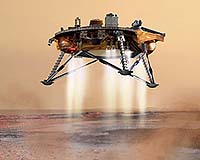
Paris, France (ESA) Feb 29, 2008 A trio of NASA and ESA spacecraft orbiting Mars are preparing for the 25 May arrival of NASA's Phoenix lander. ESA's Mars Express has already started adjusting its orbit to provide critical back-up monitoring of Phoenix. In May, when Phoenix enters the Red Planet's atmosphere at over 20 000 km/h, two NASA spacecraft - Mars Odyssey and the Mars Reconnaissance Orbiter - will closely monitor the stream of data being transmitted. In case anything goes wrong, NASA has requested that ESA's Mars Express, which has been in orbit around Mars since December 2003, also monitors the 13-minute entry, descent and landing (EDL) phase. Flight controllers at ESA's Space Operations Centre (ESOC), Darmstadt, Germany, began optimising the Mars Express orbit in November and December 2007, so that in May the spacecraft will have an orbit that is properly 'phased' and provides good visibility of Phoenix's planned trajectory. A series of orbital adjustments were already necessary for Mars Express science operations, so it cost little additional fuel to accommodate NASA's request. Final orbital adjustments may still be required depending on Phoenix's final trajectory. High-speed slew to track Phoenix descent Operations and flight dynamics specialists at ESOC have also designed and tested an 'EDL pointing mode' for Mars Express, which allows the spacecraft's MELACOM (Mars Express Lander Communications system) to point towards Phoenix during EDL. The instrument was originally intended for communications with the Beagle lander. Mars Express will perform a high-speed slew as MELACOM tracks Phoenix, rotating about one axis at a speed some two to three times faster than normal; this action has already been tested and confirmed. MELACOM will receive data from Phoenix that will enable NASA to confirm the lander's speed and acceleration through the Mars atmosphere. At NASA's request, ESA's Mars Express team at ESOC has also designed and implemented a 'lander pointing mode'. This will enable Mars Express to look down and transmit telecommands to Phoenix and receive data from it on the surface. It will provide a critical back-up to NASA and potentially boost science return. "Last year, we practised relaying commands from NASA to Mars Express and then down to the surface, using NASA's Mars Rovers as stand-in for Phoenix. It worked fine," said Michel Denis, Mars Express Spacecraft Operations Manager at ESOC.
Mars Express will help characterise the descent trajectory The Ultraviolet and Infrared Atmospheric Spectrometer (SPICAM) will also be used for sounding measurements of the atmosphere, prior to the event, to study the density of carbon dioxide at altitudes of 50 to 150 km. Mars Express mission scientists are also studying whether instruments such as the HRSC (High Resolution Stereo Camera) and SPICAM can also detect the entry emission of Phoenix, providing additional analysis of the martian atmosphere when it is heated by the lander's passage. NASA and ESA ground stations will also cooperate to perform highly sophisticated 'delta-DOR' (delta - Differential One-way Range) interferometry measurements to determine the trajectory of Phoenix with high precision. This is the first time that ESA has been able to operationally support NASA with the delta-DOR equipment installed at the Agency's two deep-space tracking stations, in Cebreros, Spain, and New Norcia, Australia. "In many ways, we are returning a favour," said Peter Schmitz, ESA's Mars Express Deputy Spacecraft Operations Manager. "NASA helped us out similarly with Mars Express, prior to its arrival at the Red Planet, when we still didn't have the delta-DOR system in service." Community Email This Article Comment On This Article Related Links Mars News and Information at MarsDaily.com Lunar Dreams and more
 Traces Of The Martian Past In The Terby Crater
 Paris, France (ESA) Jan 28, 2008
The High Resolution Stereo Camera (HRSC) on board ESA's Mars Express has returned striking scenes of the Terby crater on Mars. The region is of great scientific interest as it holds information on the role of water in the history of the planet. |
|
|

| The content herein, unless otherwise known to be public domain, are Copyright 1995-2007 - SpaceDaily.AFP and UPI Wire Stories are copyright Agence France-Presse and United Press International. ESA Portal Reports are copyright European Space Agency. All NASA sourced material is public domain. Additional copyrights may apply in whole or part to other bona fide parties. Advertising does not imply endorsement,agreement or approval of any opinions, statements or information provided by SpaceDaily on any Web page published or hosted by SpaceDaily. Privacy Statement |