|
 |
 |
 |
 |
 |
 |
 |
 |

 |
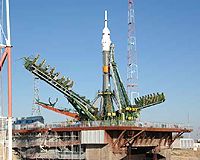
Malaysian astronaut's rocket rolled out to launchpad
Baikonur, Kazakhstan (AFP) Oct 8, 2007 The Russian rocket due to take Malaysia's first astronaut into orbit was raised into position on Monday ready for a launch seen by Malaysian officials as a national milestone. The 50-metre (160-foot) Soyuz rocket bearing the Malaysian, Russian and US flags was eased out of its hangar by a train locomotive for the five-kilometre (three-mile) journey to its launch pad as the sun broke over the horizon at Baikonur cosmodrome. Sheikh Muszaphar Shukor, a doctor and part-time model, is to blast off on Wednesday to the International Space Station (ISS) with Russian cosmonaut Yury Malenchenko and American Peggy Whitson. "I can't believe how close we are. To see the Malaysian flag and the Malaysian crest on there is amazing," said aerospace engineer Shankini Doraisingam, as the rocket began its journey guarded by armed police. Muszaphar has attracted interest with a promise that he will, if possible, observe the fasting regime of the Muslim holy month of Ramadan on the ISS. Malaysian religious authorities have prepared guidelines on how to adapt the rules as the ISS circles the Earth 16 times each calendar day, which would technically mean having to pray 80 times every 24 hours, and cause havoc with the Ramadan rule on fasting between dawn and dusk. Muszaphar will treat the crew to Malaysian food including traditional biscuits eaten when Ramadan ends with a public holiday in Malaysia on October 12, said Doraisingam. Muszaphar was said by reserve astronaut Faiz Khaleed to be "a bit nervous," but mainly focussed on scientific experiments he will conduct. These involve seeing how cancer cells respond to treatment in weightless conditions, where they will be able to grow in three dimensions and thus in a similar way to inside the human body, said project director Zulkeffeli Mat Jusoh. Malaysia is paying for the voyage as part of a billion-dollar purchase of Russian fighter jets. Russia built the Baikonur cosmodrome on the arid plains of Kazakhstan in Soviet times and has continued to use the site under a rental deal since the 1991 Soviet collapse. Russia is marking 50 years of space exploration, having celebrated on October 4 the 50th anniversary of the launch of the first ever satellite, Sputnik. Community Email This Article Comment On This Article Related Links Space Tourism, Space Transport and Space Exploration News
 Russia readies rocket for Malaysian's space launch
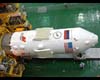 Baikonur, Kazakhstan (AFP) Oct 7, 2007
Russian engineers put the final touches on Sunday to a Soyuz spacecraft in which Malaysia's soon-to-be first astronaut Sheikh Muszaphar Shukor will fly to the International Space Station. |
|
|

| The content herein, unless otherwise known to be public domain, are Copyright 1995-2007 - SpaceDaily.AFP and UPI Wire Stories are copyright Agence France-Presse and United Press International. ESA Portal Reports are copyright European Space Agency. All NASA sourced material is public domain. Additional copyrights may apply in whole or part to other bona fide parties. Advertising does not imply endorsement,agreement or approval of any opinions, statements or information provided by SpaceDaily on any Web page published or hosted by SpaceDaily. Privacy Statement |