|
 |
 |
 |
 |
 |
 |
 |
 |

 |
Malaysia's MEASAT Sends Third Satellite Into Space
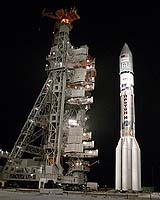
Kuala Lumpur (AFP) Dec 12, 2006 Malaysian firm MEASAT Satellite Systems Tuesday sent its third satellite into space, a move leaders hailed as a milestone in the country's technological achievements and a huge boost to the company's communications reach. The MEASAT-3 satellite, built by Boeing with a project cost of one billion ringgit (281.13 million dollars), was launched at 7.28 am local time (1130 GMT) from the Baikonur Cosmodrome in Kazakhstan. "It is our proud moment ... It demonstrates that we are serious in the development of satellite technology communication because we want to be a serious player in the application of such technology," Prime Minister Abdullah Ahmad Badawi said in special message to mark the launch. The satellite was sent off on a Proton Breeeze-M rocket, whose flight will last about nine hours and 12 minutes before separating from the satellite. "The lift off of the Proton went exactly to plan," MEASAT's director, Mohammad Hanif Omar said in a statement. After separation, the satellite will be manoeuvred into its orbital location and undergo a series of tests expected to be completed by February 1 next year, the company said. When operational, MEASAT-3 will boost the capacity of Malaysian operator's key orbital position by some 300 percent, extending its reach to more than 100 countries and allowing it to deliver more communication services. "This significant investment by MEASAT is more than a private venture. Indeed, it carries with it into space the aspirations of an entire nation," Deputy Prime Minister Najib Razak said in a speech as he witnessed the launch. Najib hailed MEASAT for boosting Malaysia's technological advancement, saying its satellites were increasing access to telecommunications, television and Internet services in remote areas of the country. Malaysia has also embarked on an ambitious space program which in October saw it launching Southeast Asia's first space centre, with its first astronaut due to blast off next year. "With Malaysia's foray into space science ... and complemented by initiatives like this one from MEASAT, Malaysians can see that there is no barrier that we cannot overcome, no frontier that we cannot explore," Najib said. MEASAT is a wholly-owned subsidiary of the listed MEASAT Global, whose shareholders include government-linked companies such as Telekom Malaysia, which owns a 15 percent stake. It currently operates two satellite networks, providing communications services to broadcasters across Asia and Australia. MEASAT-3, which has an orbit mission life of about 15 years, will provide 24 C-band transponders with coverage across a region bounded by Africa and Eastern Europe in the west, to Japan and Australia in the east.
Source: Agence France-Presse Community Email This Article Comment On This Article Related Links Integrated Defense Systems MEASAT Satellite Systems The latest information about the Commercial Satellite Industry The latest information about the Commercial Satellite Industry
 New ESA Website Targeting SMEs
 Paris, France (ESA) Dec 11, 2006
Innovations from small high-tech companies are of high value to Europe's space industry, and since 1997 ESA has taken special measures to encourage this type of firm to get involved in its space programmes, and with this new program ESA now offers a dedicated website to further promote this initiative: the Small and Medium Sized Enterprises (SMEs) website. |
|
|

| The content herein, unless otherwise known to be public domain, are Copyright 1995-2006 - SpaceDaily.AFP and UPI Wire Stories are copyright Agence France-Presse and United Press International. ESA PortalReports are copyright European Space Agency. All NASA sourced material is public domain. Additionalcopyrights may apply in whole or part to other bona fide parties. Advertising does not imply endorsement,agreement or approval of any opinions, statements or information provided by SpaceDaily on any Web page published or hosted by SpaceDaily. Privacy Statement |