|
 |
 |
 |
 |
 |
 |
 |
 |

 |
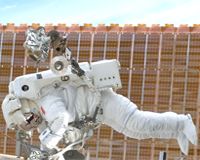
MIT seeks funding for elastic spacesuit
Boston (UPI) Dec 26, 2007 Scientists at the Massachusetts Institute of Technology are seeking funding to develop a skin-tight, next-generation spacesuit for a possible mission to Mars. The lightweight, stretchable "Bio-Suit" was envisioned by NASA in the 1990s, but funding to develop the futurist garment dried up. A team of MIT researchers and engineers believe they could develop a prototype suit and have it ready for production by 2012, The Boston Herald reported Wednesday. "It is possible that this could be worn by astronauts by the time we go back to the moon in 2020 and could even be worn to Mars," said David Newman, an aeronautics and aerospace professor who heads the "Bio-Suit" project at MIT. The spandex and nylon spacesuit would be perfectly tailored to fit in the vacuum of space but would be extremely difficult to put on while on Earth, the newspaper said. Air pressure in a "Bio-Suit" would be directly on the skin of the wearer instead of inside the bulky pressurized spacesuits used today, Newman said. Community Email This Article Comment On This Article Related Links Space Tourism, Space Transport and Space Exploration News
 SPACEHAB Announces Successful ARCTUS Mid-Air Recovery Test
 Houston TX (SPX) Dec 20, 2007
SPACEHAB has announced the success of a mid air retrieval demonstration test performed with applications to its Advanced Research and Conventional Technology Utilization Spacecraft (ARCTUS) Program. The Company is releasing video of the successful test on SPACEHAB's ARCTUS Program website. |
|
|

| The content herein, unless otherwise known to be public domain, are Copyright 1995-2007 - SpaceDaily.AFP and UPI Wire Stories are copyright Agence France-Presse and United Press International. ESA Portal Reports are copyright European Space Agency. All NASA sourced material is public domain. Additional copyrights may apply in whole or part to other bona fide parties. Advertising does not imply endorsement,agreement or approval of any opinions, statements or information provided by SpaceDaily on any Web page published or hosted by SpaceDaily. Privacy Statement |