|
 |
 |
 |
 |
 |
 |
 |
 |

 |
MESSENGER Only One Week From Mercury
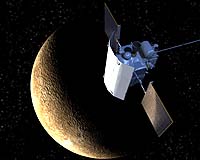
Laurel MD (SPX) Jan 08, 2008 MESSENGER"s mid-December trajectory correction maneuver (TCM-19) went so well that the mission"s design and navigation teams have decided that a TCM scheduled for January 10 will not be needed. "Cancellation of this maneuver is a demonstration of the near-perfect execution of TCM-19 just prior to the start of the holiday season," says Mission Systems Engineer Eric Finnegan of the Johns Hopkins University Applied Physics Laboratory in Laurel, Md. On January 9, MESSENGER"s Mercury Dual Imaging System cameras will begin gathering pictures of Mercury as the probe zeros in on the planet. "With just one week to go before the flyby, the spacecraft is on target to encounter the planet at an altitude of 202 kilometers," Finnegan says. "All subsystems and instruments are operating nominally and configured for the start of the flyby sequence, except for the Mercury Laser Altimeter and part of the Gamma-Ray Spectrometer, which we"ll turn on just before the flyby." Over the next week, the team will make final flyby preparations and upload the final command sequences for the encounter. "We are about to visit Mercury for the first time in more than 30 years, and we can"t wait," says MESSENGER Principal Investigator Sean Solomon of the Carnegie Institution of Washington. "In addition to providing the critical gravity assist that will move MESSENGER along its path toward Mercury orbit insertion in March 2011, this flyby will let us see parts of Mercury never before viewed by spacecraft. We"ll be making close-in observations of the composition of Mercury"s surface and atmosphere, and we"ll be probing deeper into the planet"s magnetosphere than we"ve ever been. We expect many surprises."
Experience MESSENGER"s Mercury Flyby Virtually This tool combines the best available image map of Mercury"s surface with observation sequences for the Mercury Dual Imaging System (MDIS), Mercury Atmospheric and Surface Composition Spectrometer (MASCS), and Mercury Laser Altimeter (MLA). The map of Mercury"s surface combines Earth-based low-resolution radar images from the Arecibo Observatory in Puerto Rico and image mosaics from the Mariner 10 spacecraft flybys of Mercury in 1974 and 1975. There are many helpful tips available on the pages of this visualization tool. Pointing and clicking on any color bar will either reveal the projection of each completed image mosaic on Mercury or show the end of the active MLA or MASCS observation. Information accompanying each simulated image includes the latitude and longitude of the point at the center of each image, the resolution in meters (or kilometers when farther from the planet) per pixel (picture element) at the image center, the altitude (how far the spacecraft is above Mercury's surface), and the time relative to closest approach. Community Email This Article Comment On This Article Related Links MESSENGER Mission News Johns Hopkins University Applied Physics Laboratory News Flash at Mercury Mars News and Information at MarsDaily.com Lunar Dreams and more
 Messenger Zeros In On Mercury
 Laurel MD (SPX) Dec 24, 2007
Messenger's nineteenth trajectory-correction maneuver (TCM-19) completed on December 19 lasted 110 seconds and adjusted the spacecraft's velocity by 1.1 meters per second (3.6 feet per second). The movement targeted the spacecraft close to the intended aim point 200 km (124 miles) above the night-side surface of Mercury for the probe's first flyby of that planet on January 14, 2008. |
|
|

| The content herein, unless otherwise known to be public domain, are Copyright 1995-2007 - SpaceDaily.AFP and UPI Wire Stories are copyright Agence France-Presse and United Press International. ESA Portal Reports are copyright European Space Agency. All NASA sourced material is public domain. Additional copyrights may apply in whole or part to other bona fide parties. Advertising does not imply endorsement,agreement or approval of any opinions, statements or information provided by SpaceDaily on any Web page published or hosted by SpaceDaily. Privacy Statement |