
 |
 |
 |
 |
 |
 |
 |
 |
 |

 |
Messenger Zeros In On Mercury
Laurel MD (SPX) Dec 24, 2007 Messenger's nineteenth trajectory-correction maneuver (TCM-19) completed on December 19 lasted 110 seconds and adjusted the spacecraft's velocity by 1.1 meters per second (3.6 feet per second). The movement targeted the spacecraft close to the intended aim point 200 km (124 miles) above the night-side surface of Mercury for the probe's first flyby of that planet on January 14, 2008. The maneuver started at 5:00 p.m. EDT. Mission controllers at The Johns Hopkins University Applied Physics Laboratory (APL) in Laurel, Md., verified the start of TCM-19 about 13 minutes later, after the first signals indicating thruster activity reached NASA's Deep Space Network tracking station outside Canberra, Australia. "The Messenger spacecraft's TCM-19 is one in a series of potential course correction opportunities planned in advance of the first Mercury flyby," explained APL's Eric Finnegan, Messenger's Mission Systems Engineer. "TCM-19 corrected small deviations in the trajectory remaining after the successful execution of the deep-space maneuver on October 18." "We're now set for our flyby," added Messenger Principal Investigator Sean Solomon. "Achieving our aim point not only will give us our first close-up view of Mercury in nearly 33 years; it will ensure that we continue on the trajectory needed to place, for the first time, a spacecraft into orbit around the innermost planet three years later." Community Email This Article Comment On This Article Related Links Mercury Messenger Maneuvers News Flash at Mercury Mars News and Information at MarsDaily.com Lunar Dreams and more
 Messenger Exits Longest Solar Conjunction Period of Mission
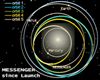 Laurel MD (SPX) Dec 07, 2007
On Friday, November 30, the Messenger team resumed daily contact with its Mercury-bound spacecraft. Engineers had suspended their contact schedule on November 13 as the Sun-Earth-Probe angle passed below 1 degree - entering a period known as solar conjunction, when the spacecraft's trajectory moved it to the opposite side of the Sun from Earth and out of radio contact with NASA's Deep Space Network for several weeks. |
|
|

| The content herein, unless otherwise known to be public domain, are Copyright 1995-2007 - SpaceDaily.AFP and UPI Wire Stories are copyright Agence France-Presse and United Press International. ESA Portal Reports are copyright European Space Agency. All NASA sourced material is public domain. Additional copyrights may apply in whole or part to other bona fide parties. Advertising does not imply endorsement,agreement or approval of any opinions, statements or information provided by SpaceDaily on any Web page published or hosted by SpaceDaily. Privacy Statement |

