|
 |
 |
 |
 |
 |
 |
 |
 |

 |
MESSENGER: Craters With Dark Halos On Mercury
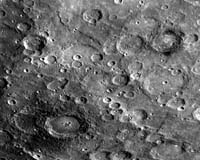
Laurel MD (SPX) Feb 25, 2008 As MESSENGER flew by Mercury on January 14, 2008, the Narrow Angle Camera (NAC) of the Mercury Dual Imaging System (MDIS) captured this view. Two of the larger craters in this image appear to have darkened crater rims and partial "halos" of dark material immediately surrounding the craters. Both craters appear to have nearly complete rims and interior terraced walls, suggesting that they formed more recently than the other nearby shallower craters of similar size. There are two possible explanations for their dark halos: 1/ Darker subsurface material may have been excavated during the explosions from the asteroid or comet impacts that produced the craters. 2/ Large cratering explosions may have melted a fraction of the rocky surface material involved in the explosions, splashing so-called "impact melts" across the surface; such melted rock is often darker (lower albedo) than the pre-impact target material. In either case, the association of the dark material with relatively recently formed craters suggests that the processes that gradually homogenize Mercury's surface materials have not yet had time to reduce the contrast of these dark halos. The crater with associated dark material in the lower-left part of this image is about 100 kilometers (60 miles) in diameter, and the crater with patches of dark material in the upper right is about 70 kilometers (40 miles) across. These dark-halo craters, located near Mercury's south pole, are also visible in the previously released false-color image created from three Wide Angle Camera (WAC) frames. Information from images taken in the 11 different color filters of the WAC will help MESSENGER scientists understand the nature of the dark material associated with the craters shown in this image and will determine whether they reveal the presence of subsurface material of a different composition, are examples of impact melt, or perhaps have some other explanation. Community Email This Article Comment On This Article Related Links MESSENGER's first flyby of Mercury News Flash at Mercury Mars News and Information at MarsDaily.com Lunar Dreams and more
 Messenger Team Begins Planning For Second Mercury Encounter
 Pasadena CA (JPL) Feb 08, 2008
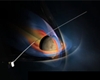
Little more than three weeks after Messenger's first historic flyby of Mercury, the team this week began mapping out its trajectory and observation plans for the probe's second pass of the planet this fall. On October 6, 2008, at 4:39 a.m. EST, the spacecraft will once again fly 200 kilometers (124 miles) above the surface of the planet. |
|
|

| The content herein, unless otherwise known to be public domain, are Copyright 1995-2007 - SpaceDaily.AFP and UPI Wire Stories are copyright Agence France-Presse and United Press International. ESA Portal Reports are copyright European Space Agency. All NASA sourced material is public domain. Additional copyrights may apply in whole or part to other bona fide parties. Advertising does not imply endorsement,agreement or approval of any opinions, statements or information provided by SpaceDaily on any Web page published or hosted by SpaceDaily. Privacy Statement |