|
 |
 |
 |
 |
 |
 |
 |
 |

 |
Messenger Team Begins Planning For Second Mercury Encounter
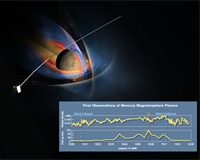
Pasadena CA (JPL) Feb 08, 2008 Little more than three weeks after Messenger's first historic flyby of Mercury, the team this week began mapping out its trajectory and observation plans for the probe's second pass of the planet this fall. On October 6, 2008, at 4:39 a.m. EST, the spacecraft will once again fly 200 kilometers (124 miles) above the surface of the planet. This is the second of three scheduled passes of Mercury, each designed to provide a critical gravity assist needed to keep Messenger on track for its March 2011 orbit insertion around the planet. As with the first flyby on January 14, 2008, the spacecraft's full suite of instruments will be operating. + The Mercury Dual Imaging System will gather color observations of Mercury's surface in 11 filters, and its Narrow Angle Camera will image high-resolution monochrome measurements near the equator. + The Magnetometer and the Energetic Particle and Plasma Spectrometer will explore the planet's magnetosphere at low altitude, near Mercury's equator. + The ultraviolet and visible spectrometer on the Mercury Atmospheric and Surface Composition Spectrometer (MASCS) will make observations of chemical species in the exosphere and tail, and the MASCS visible and infrared spectrograph will make spectral measurements of Mercury's surface. + The Neutron Spectrometer will make measurements of the neutron flux that may yield estimates of iron and thallium abundances near Messenger's ground track. + The Mercury Laser Altimeter (MLA) will acquire another topographic profile of Mercury's surface, shedding light on the planet's geographic history. + The X-Ray Spectrometer (XRS) and Gamma-Ray Spectrometer will measure X-ray and gamma-ray emissions from the surface of Mercury and look for characteristic "signatures" in those emissions to determine its elemental composition. "Observations during this second Messenger flyby will almost complete the first high-resolution viewing of Mercury, adding another one-third of the planet surface to the 21% of territory not seen by Mariner 10 and first imaged by Messenger in January 2008," says Messenger Project Scientist Ralph McNutt. "This second flyby will also provide an important new view of the time-variable exosphere and magnetosphere, adding to our knowledge of how Mercury responds to its variable interplanetary environment as a system." Messenger is now approximately 0.35 Astronomical Units (AU) from the Sun (1 AU equals 93 million miles) and will reach its next local maximum Sun distance of 0.70 AU at the end of March. Most of the instruments are still on, but they will all be turned off in preparation for the second in-flight main processor software load scheduled for February 27, 2008. The first software load was conducted on October 24, 2005. "This load - planned more than a year ago - will execute the third Deep Space Maneuver on March 19 using new software," explains Messenger Operations Manager Andy Calloway. He adds: "In addition to these two top priorities and the second Mercury flyby planning, the team will be focusing on orbital operations with a third 'day in the life' test. This will be the first test using the latest science planning software and will include orbital eclipse operations along with hot planet fly-over constraints." Meanwhile, Messenger's science team is busy analyzing data from the first flyby in preparation for almost two dozen presentations planned to be given at the 39th Lunar and Planetary Science Conference in early March. "Our second flyby will occur one and a half Mercury solar days after our first, and as a result the nightside we flew over in January will be in daylight in October,' says Messenger Principal Investigator Sean Solomon. "Once again, we will be seeing territory never before viewed at close range. Three weeks ago we were reminded how many surprises Mercury has in store for us. We expect to be surprised again this October." Community Email This Article Comment On This Article Related Links Mercury's Geological Architecture News Flash at Mercury Mars News and Information at MarsDaily.com Lunar Dreams and more
 Boston University Astronomers Map Full Extent Of Mercury's Comet-Like Tail
 Boston MA (SPX) Feb 07, 2008
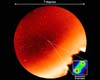
Boston University astronomers released new images of Mercury that capture both the source regions of and, for the first time, the extraordinary length of the planet's comet-like tail. Earlier research had mapped-out Mercury's sodium gas tail to approximately 40,000 kilometers, but planetary scientists from BU's Center for Space Physics (CSP) have found that the tail can extend more than 2.5 million kilometers, or 1.5 million miles, from the planet. |
|
|

| The content herein, unless otherwise known to be public domain, are Copyright 1995-2007 - SpaceDaily.AFP and UPI Wire Stories are copyright Agence France-Presse and United Press International. ESA Portal Reports are copyright European Space Agency. All NASA sourced material is public domain. Additional copyrights may apply in whole or part to other bona fide parties. Advertising does not imply endorsement,agreement or approval of any opinions, statements or information provided by SpaceDaily on any Web page published or hosted by SpaceDaily. Privacy Statement |