|
 |
 |
 |
 |
 |
 |
 |
 |

 |
Liquid Jungle Lab Environs Are Home To Five New Species
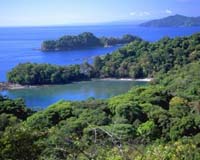
Panama, Panama (SPX) Jun 25, 2006 On 15 June, 2006, the first publication to assemble terrestrial biodiversity information from Bahia Honda, Panama, was presented by Santiago Castroviejo and Alicia Ibaez, editors, at the Smithsonian Tropical Research Institute (STRI) in Panama City. The new, 835-page, bilingual volume: "Studies on the Biodiversity of the Baha�a Honda Region (Veraguas, Panama)," contains an initial inventory of the sparsely-populated, highly-disturbed pastureland and tropical forest around the bay and on Canales de Tierra Island, site of the Liquid Jungle Lab. "Whereas the Province of Veraguas is well-known to historians as the only piece of the New World awarded to Colombus' decendents--the "Dukes of Veraguas"-- by scientific standards it is still terra ignota," remarked Stanley Heckadon-Moreno, STRI anthropologist, at the book presentation. Santiago Castroviejo, botanist from the Royal Botanical Gardens in Madrid, first came to Panama in 1993 as consultant on a project to conserve a starkly beautiful piece of rainforest on Coiba Island�"then a penal colony-- about 10 miles southwest of Bahia Honda. After publishing the Flora y Fauna de Parque Nacional de Coiba in 1997, he didn't expect to return to Panama. But in February 2000 he did return at the request of two businessmen, Jean Pigozzi and Daniel Wolf, who had purchased 6,000 ha around Bahia Honda to set aside as a reserve and to establish what is now the Liquid Jungle Lab. In the end, twenty-one authors from six countries and five institutions contributed to the inventory. The initial chapter by Alicia Ibaez provides geological history and biophysical context. Remnant islands generated by the Galapagos hotspot that later migrated East and the subsequent volcanic and emergent terrains that formed the Isthmus of Panama form the steep and deeply faulted lands of southern Veraguas. Average rainfall is thought to be ~3500mm per year. Roughly 2,000 inhabitants subsist by fishing and livestock farming. Most of the area is accessible only by boat. Subsequent chapters offer literature reviews and photographs of higher plants (Alicia Ibaez, Santiago Castroviejo, JosA Luis Fernandez Alonso and Mireya D. Correa) , lichens and fungi (Javier Etayo and AndrA Aptroot), mosses and liverworts (Noris Salazar Allen and Clementina Chung C.), birds (Belkys JimAnez and Karla Aparicio), butterflies (Annette Aiello, Vicente RodrA�guez Gracia, Vitor Osmar Becker and Olga of Greece), spiders and scorpions (Diomedes Quintero Arias), reptiles and amphibians (Victor MartA�nez Cortes and Abdiel RodrA�guez) and mammals (Rafael Samudio and Jorge Pino). Species new to science include a fungus (Opegrapha pigozziana), named for Jean Pigozzi, a lichen (Pyrenula luteopruinosa) and an epiphytic plant in the family Araceae (Monstera sp. nov), which will be described in a forthcoming publication by a specialist at the Missouri Botanical Gardens. New animal species include a wasp (Foxita cambrai) and a never-before described male spider (Amphidraus sp. nov), collected and characterized by entomologists at the University of Panama. Bahia Honda forms part of the buffer zone of Panama's newly established Coiba National Park and UNESCO World Heritage site. This hefty volume will be essential gear for the shapers of a new Management Plan for Coiba and for visitors to the Liquid Jungle Lab. The terrestrial inventory will also serve as a valuable baseline for a project to reforest mainland areas with native tree species (PRORENA) sponsored by the Yale School of Forestry & Environmental Studies and the Center for Tropical Forest Science at STRI. Researchers and students from Woods Hole Oceanographic Institute and others will continue to inventory the region's marine organisms. Castroviejo pointed out that the amount of new scientific information resulting from a survey of such a highly disturbed landscape underscores the desperate need for more basic field inventory work and for the conservation of altered landscapes in Panama and worldwide. "To date we have named roughly 1.5 million organisms, and we suspect there are 3 to 5 million more organisms that have not even been named. Some say that 25-30% of these species will go extinct before we have a chance to name them if the current rate of habitat destruction persists." Community Email This Article Comment On This Article Related Links Smithsonian Tropical Research Institute Darwin Today At TerraDaily.com
 Showing Off Your Weapons In The Animal Kingdom
 Flagstaff AZ (SPX) Jun 27, 2006
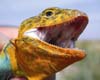
Working at the Wichita Mountains National Wildlife Refuge in Oklahoma, researchers have shown that when an adult male lizard gapes his jaws at a rival male during an intense territorial interaction, information is made available to his opponent about how hard he can bite - indeed, the lizard's jaw muscles become clearly visible. |
|
|

| The content herein, unless otherwise known to be public domain, are Copyright 1995-2006 - SpaceDaily.AFP and UPI Wire Stories are copyright Agence France-Presse and United Press International. ESA PortalReports are copyright European Space Agency. All NASA sourced material is public domain. Additionalcopyrights may apply in whole or part to other bona fide parties. Advertising does not imply endorsement,agreement or approval of any opinions, statements or information provided by SpaceDaily on any Web page published or hosted by SpaceDaily. Privacy Statement |