|
 |
 |
 |
 |
 |
 |
 |
 |

 |
Lead With A Poisonous Electron Shield
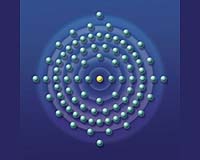
Paris, France (SPX) Jan 18, 2007 It has been speculated that lead poisoning may have played a role in the fall of the Roman Empire: it is thought to have been caused by the concentration of grape juice in lead containers. Though the introduction of lead-free gasoline has reduced damage to the environment, the annual production of lead continues to increase worldwide because lead is still used in batteries, glass, and electronic components. However, there has thus far been little research into what, at a molecular level, causes the toxic effects of lead. French researchers have now applied quantum chemistry to very simple enzyme models and gained new insights. As they have reported in Angewandte Chemie, it seems that the lead's "electron shield" is the main culprit. Lead does the most damage to the nervous system, kidneys, liver, brain, and blood. These kinds of damage are especially severe for children as they can be irreversible. Complexation agents that grab onto the metal cations are used as antidotes. However, these agents are not lead-specific, meaning that they also remove other important metal cations from the body. C. Gourlaouen and O. Parisel (Laboratoire de Chimie Theorique, Universite Paris 6) took a closer look at two proteins to which lead likes to bind. Calmodulin, a calcium-binding protein, plays an important role in regulating and transporting the calcium cation in the human body. A calcium ion binds to seven ligands at the active centers of the enzyme. If one of the four possible calcium ions of calmodulin is replaced by lead, the lead ion remains roughly heptacoordinated, but this active center becomes distorted and inefficient; the three remaining sites get a reduced efficiency. d-Aminolevulinic acid dehydratase is essential for the biosynthesis of hemoglobin. Inhibition of this enzyme disrupts the formation of blood to the point of anemia. At the active center, a zinc ion binds to four ligands, three of which involve a sulfur atom. When lead replaces zinc, it only binds to the three sulfur atoms. The reason for this is the emerging free electron pair of the lead cation. It acts as an electronic shield on one side, pushing away the fourth ligand. Such a dramatic geometrical distortion at the active center could explain why lead inhibits this enzyme. The different behavior of lead in these two enzymes demonstrates that it can enter into complexes in which the metal-ligand bonds can either point in all directions, or into only one hemisphere, while the other hemisphere is filled by the free electron pair. This observation may help in the design of future lead-specific antidotes. Community Email This Article Comment On This Article Related Links Laboratoire de Chimie Theorique, Universite Paris Our Polluted World and Cleaning It Up Our Polluted World and Cleaning It Up
 Oil Slick Fouls Hundreds Of Birds Off Norway
 Oslo (AFP) Jan 15, 2007
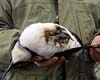
An oil slick from a grounded cargo ship off Norway's west coast has covered some 440 birds in oil and that number is expected to rise, ornithologists said on Monday. "The situation is dramatic for birds. We are expecting a lot of deaths," Frode Falkenberg, an ornithologist with the Norwegian ornithological association NOF, told AFP. |
|
|

| The content herein, unless otherwise known to be public domain, are Copyright 1995-2006 - SpaceDaily.AFP and UPI Wire Stories are copyright Agence France-Presse and United Press International. ESA PortalReports are copyright European Space Agency. All NASA sourced material is public domain. Additionalcopyrights may apply in whole or part to other bona fide parties. Advertising does not imply endorsement,agreement or approval of any opinions, statements or information provided by SpaceDaily on any Web page published or hosted by SpaceDaily. Privacy Statement |