|
 |
 |
 |
 |
 |
 |
 |
 |

 |
Largest Flower Evolved From Family Of Much Tinier Blooms
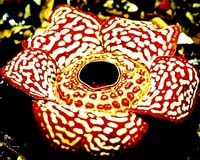
Boston MA (SPX) Jan 15, 2007 The plant with the world's largest flower -- typically a full meter across, with a bud the size of a basketball -- evolved from a family of plants whose blossoms are nearly all tiny, botanists write this week in the journal Science. Their genetic analysis of rafflesia reveals that it is closely related to a family that includes poinsettias, the trees that produce natural rubber, castor oil plants, and the tropical root crop cassava. The team from Harvard University, Southern Illinois University, the Smithsonian Institution, and the University of Wisconsin was led by Harvard's Charles C. Davis. "For nearly 200 years rafflesia's lineage has confounded plant scientists," says Davis, an assistant professor of organismic and evolutionary biology in Harvard's Faculty of Arts and Sciences. "As a parasite living inside the tissue of a tropical vine, the plant lacks leaves, shoots, or roots, making it difficult to compare to more conventional plants. Most efforts to place plants in the botanical tree of life in the past 25 years have tracked ancestry using molecular markers in genes governing photosynthesis. Rafflesia is a non-photosynthetic parasite, and those genes have apparently been abandoned, meaning that to determine its lineage we had to look at other parts of the plant's genome." Davis and his colleagues determined that over an estimated 46 million years, rafflesia's blooms, which now weigh up to 15 lbs., evolved at an accelerated pace. However, after increasing in size by a factor of roughly 79, the plant then reverted to a more sedate evolutionary pace. This evolutionary spurt is one of the most dramatic size changes ever reported among eukaryotes; if humans were to undergo comparable evolutionary growth, Davis says, an average man would end up some 146 meters tall, roughly the height of the Great Pyramid of Giza. Because rafflesia lacks the genes most commonly used to trace plant ancestry, the scientists delved deeper into the genome, looking at some 11,500 base pairs of DNA to determine that the giant flower's closest relatives are in the Euphorbiaceae family, many of which have blossoms just a few millimeters in diameter. "The power of nucleic acid comparisons is revealed as well as ever in this stunning deduction," says noted botanist Peter H. Raven, president of the Missouri Botanical Garden in St. Louis, who was not involved in this research. "The massive increase in flower size is one of the most significant among living organisms, and could never have been deduced by conventional methods." Found growing on the jungle floor in parts of southeastern Asia, rafflesia is unusual in more than just its flower's size. A parasite, it derives its nutrients from a plant in the grapevine family and lacks leaves, stems, or roots. Even more shocking is the plant's carcass-like appearance: Its blooms are a mottled blood red, reek of decaying flesh, and in some cases even emit heat, much like a recently killed animal. These traits help the flower attract the carrion flies that pollinate it. "While it's surprising to find this giant plant evolved from a family typified by much smaller blossoms, rafflesia is unusual enough that it's frankly been difficult to imagine it fitting neatly into any plant family," Davis says. "Many botanists had refused to even speculate on where this botanical outlier might fit into the tree of life." Rafflesia was first discovered in the Sumatran rain forest some 180 years ago by Sir Stamford Raffles, governor of the East India Company's establishments in Sumatra, and Joseph Arnold, a naturalist and physician. Shortly before Arnold died of malaria on that same expedition, he described rafflesia as "the greatest prodigy of the vegetable world," adding, "To tell you the truth, had I been alone, and had there been no witnesses, I should think I would have been fearful of mentioning the dimensions of this flower, so much does it exceed every flower I have ever seen or heard of." Davis' co-authors on the Science paper are Maribeth Latvis of Harvard's Department of Organismic and Evolutionary Biology; Daniel L. Nickrent of Southern Illinois University; Kenneth J. Wurdack of the Smithsonian Institution; and David A. Baum of the University of Wisconsin. Their work was supported by the National Science Foundation, the Department of Organismic and Evolutionary Biology at Harvard, and the Michigan Society of Fellows. Community Email This Article Comment On This Article Related Links Harvard University Darwin Today At TerraDaily.com Darwin Today At TerraDaily.com
 Scientists Discover New Life Forms In The Arctic Ocean
 Quebec City, Canada (SPX) Jan 15, 2007
An international team of scientists including Universite Laval biologist Connie Lovejoy has discovered new life forms in the Arctic Ocean. The team's findings are reported in the January 12 edition of the journal Science. |
|
|

| The content herein, unless otherwise known to be public domain, are Copyright 1995-2006 - SpaceDaily.AFP and UPI Wire Stories are copyright Agence France-Presse and United Press International. ESA PortalReports are copyright European Space Agency. All NASA sourced material is public domain. Additionalcopyrights may apply in whole or part to other bona fide parties. Advertising does not imply endorsement,agreement or approval of any opinions, statements or information provided by SpaceDaily on any Web page published or hosted by SpaceDaily. Privacy Statement |