|
 |
 |
 |
 |
 |
 |
 |
 |

 |
Landing Site for Huygens
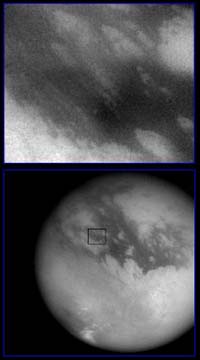
Moffett Field CA(SPX) Nov 01, 2004 On January 14, 2005, the Huygens probe will try to descend to the surface of Saturn's largest moon, Titan -a biochemically rich moon dominated by hydrocarbons like methane and ethane. These building blocks, along with Titan's dense atmosphere, make the descent one of the milestone events for astrobiology. For the first time, another world presents interesting weather combined with dynamic chemistry that is often compared to a colder version of the primordial Earth. During this week's Titan flyby, the mother ship, Cassini, turned its suite of instruments to take a closer look at where Huygens will try to land. "The combination of images, spectrometer measurements and RADAR data from this close flyby should help to prepare us for the mission ahead. In addition, Cassini's measurements of the atmosphere should confirm that the Titan atmosphere model used to design the probe entry system is correct," said Mark Leese, a member of the Huygens team at the UK Open University, who are involved in the Science Surface Package (SSP) and the Huygens Atmospheric Instrument (HASI). Twelve instruments were used on Cassini during the flyby, while the Huygens' probe will turn on another six measurement tools when it descends even closer early next year. As shown in the banner image (box, upper right), the landing site for Huygens offers a mixture of the tell-tale signs for what many speculate composes an oily shoreline. The region of interest highlights the twenty percent contrasting dark-light boundaries, with darker areas thought to have the better chance for actually being liquid and the lighter areas either rocky or methane glaciers. The left panel resolves features as small as a half-mile across, which is around 10 football fields across as seen during the Titan flyby. Scientists would like to land in the darkest spot on the moon, in hopes of increasing their chances for splashing into an oily lake, but engineering demands have guided the selection in the southern hemisphere and away from the equator. These tradeoffs are necessary to maintain communication with the Cassini probe overhead as the landing probe begins it perilous journey through methane rain, thunder, lightning and thick clouds to reach the alien surface. Methane is one of the simplest hydrocarbons, consisting of one carbon atom bound to four hydrogens. As a reactive element, carbon forms the backbone of biochemistry and organic reactions. Methane on Earth is the byproduct of decaying organic matter. When a compost pile turns to sludge, the gas given off is a mixture of methane, carbon dioxide and other hydrogen- and carbon-rich molecules. The early chemical data is being processed (left) from Cassini's ion and neutral mass spectrometer, which detects charged and neutral particles in the atmosphere. The graph shows that the amount of light nitrogen in the atmosphere of Titan is much less than that around other planets. Scientists believe this nitrogen was lost over large geologic times scales for reasons that remain unknown. The large, bottom image shows a complex interplay between dark and bright material on Titan's surface. This image was taken at a range of about 340,000 kilometers (211,000 miles), and the entire view is approximately 2,000 kilometers (1,200 miles) across. The surface appears to have been shaped by multiple geologic processes. Although a few circular features can be seen, there are no features that can be definitively identified as impact craters. Cassini scientists are studying these and other images acquired during the flyby to understand the nature and origins of the intriguing features. Community Email This Article Comment On This Article Related Links Cassini-Huygens at NASA SpaceDaily Search SpaceDaily Subscribe To SpaceDaily Express Explore The Ring World of Saturn and her moons Jupiter and its Moons The million outer planets of a star called Sol News Flash at Mercury
 Cassini Images Halo Around Titanic Moon Off Saturn
 Pasadena CA (SPX) Dec 27, 2005
With its thick, distended atmosphere, Titan's orange globe shines softly, encircled by a thin halo of purple light-scattering haze. |
|
|

| The content herein, unless otherwise known to be public domain, are Copyright 1995-2006 - SpaceDaily.AFP and UPI Wire Stories are copyright Agence France-Presse and United Press International. ESA PortalReports are copyright European Space Agency. All NASA sourced material is public domain. Additionalcopyrights may apply in whole or part to other bona fide parties. Advertising does not imply endorsement,agreement or approval of any opinions, statements or information provided by SpaceDaily on any Web page published or hosted by SpaceDaily. Privacy Statement |