
 |
 |
 |
 |
 |
 |
 |
 |
 |

 |
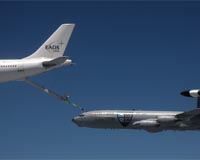
KC-45 Tanker Boom Completes Contact With AWACS Aircraft
Washington DC (SPX) Jul 25, 2008 The advanced Aerial Refueling Boom System (ARBS) for Northrop Grumman's KC-45 Tanker has performed multiple aerial contacts with an operational Airborne Warning and Control System (AWACS) aircraft, confirming its ability to support large aircraft in U.S., NATO, and allied air forces. The test mission fulfilled several key flight and program milestones for the KC-45's all-electric, fly-by-wire Aerial Refueling Boom System, including sustaining one of the tanker-to-receiver aircraft contacts to simulate large offloads. The continued successful testing of the ARBS is further indication of the boom system's maturity and readiness for the U.S. Air Force's next generation KC-45 Tanker. "The accomplishment of yet another key ARBS test program milestone is proof of the maturity of our aerial refueling capability and of the KC-45's readiness to fulfill our promise to the U.S. Air Force and the joint warfighter," said Paul Meyer, Northrop Grumman vice president and general manager of air mobility systems. "The Air Force has clearly stated they need this capability as soon as possible to replace the aging KC-135 fleet, and we offer the lowest risk, most capable solution now." The July 18 test used the exact ARBS configuration proposed for the KC-45. It was controlled by a former U.S. Air Force boom operator. The KC-45's all-electric ARBS provides highly accurate, reliable in-flight refueling, with a maximum nominal fuel flow rate of 1,200 U.S. gallons per minute. Because this boom has the largest envelope of any available in the industry, both the AWACS crew and the boom operator were impressed with the relative ease and efficiency of the refueling operation -- which replicated conditions of operational mission scenarios with the KC-45 boom and the large receiver aircraft. This follows previous in-flight evaluations that confirmed the ARBS' excellent handling qualities with large receiver platforms along with smaller and faster combat aircraft that has included the F-16, F-1, F/A-18 and C101 in previous testing. Modern fly-by-wire technology incorporated in the ARBS provides enhanced controllability and includes an automatic load alleviation system that greatly aids the boom operator -- as well as the receiver aircraft's pilot -- during refueling operations. "The ARBS is the cornerstone of the most advanced and mature Tanker in the world today and that's exactly what we must provide to our American men and woman in uniform," said John Young, CEO of EADS North America Tankers. Community Email This Article Comment On This Article Share This Article With Planet Earth
Related Links The latest in Military Technology for the 21st century at SpaceWar.com
 Outside View: Sukhoi soars again -- Part 2
 Moscow (UPI) Jul 24, 2008
 The Sukhoi Su-35 Flanker is not quite a fifth-generation combat fighter, but it comes very close to being one. |
|
|

| The content herein, unless otherwise known to be public domain, are Copyright 1995-2007 - SpaceDaily.AFP and UPI Wire Stories are copyright Agence France-Presse and United Press International. ESA Portal Reports are copyright European Space Agency. All NASA sourced material is public domain. Additional copyrights may apply in whole or part to other bona fide parties. Advertising does not imply endorsement,agreement or approval of any opinions, statements or information provided by SpaceDaily on any Web page published or hosted by SpaceDaily. Privacy Statement |
 del.icio.us
 Digg
Digg Reddit
 YahooMyWeb
 Google
 Facebook