|
 |
 |
 |
 |
 |
 |
 |
 |

 |
Japan To Resume Rocket Launches After Spy Satellite Flop
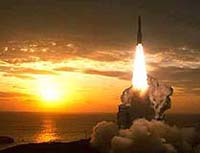
Tokyo (AFP) Dec 09, 2004 Japan said Thursday it would try again to launch its domestically developed H-2A rocket in early 2005 following last year's aborted mission to try to send two spy satellites to monitor North Korea. The seventh launch of the H-2A rocket, which is central to Japan's space program, will take place in January or in February and the rocket will carry a weather satellite, the Japan Aerospace Exploration Agency said. "Following the failed launch of the sixth H-2A rocket, we have been carefully reviewing our rocket project and now we are making preparations for the seventh launch early next year," said an agency spokeswoman. Tokyo spent 120 billion yen (1.2 billion dollars) developing the H-2A rocket before its first launch in 2001. Japan has sent up five H-2A rockets successfully, but suffered a setback in November 2003 when it had to destroy the sixth H-2A rocket just 10 minutes after lift-off. The failed test was seen as an embarrassment as it came just one month after China became the third country after the United States and the former Soviet Union to launch a successful manned space flight. The space agency has said a hole in the nozzle of a booster was to blame for the aborted mission as one of the H-2A's two rocket boosters failed to separate from the fuselage in the second phase of the flight. The sixth H-2A rocket was carrying two spy satellites to monitor military moves in North Korea. Japan was shocked after Pyongyang's ballistic missile flew over the country into the Pacific Ocean in August 1998. In March 2003, Japan sent up its first spy satellites via the fifth H-2A rocket. Community Email This Article Comment On This Article Related Links SpaceDaily Search SpaceDaily Subscribe To SpaceDaily Express Launch Pad at Space-Travel.com
 Soyuz To Launch Radarsat-2
 Evry, France (SPX) Jan 11, 2006
Starsem announced Monday the signing of a contract with MacDonald, Dettwiler and Associates (MDA) for the launch of MDA's RADARSAT-2 Earth observation satellite by a Soyuz launch vehicle. |
|
|

| The content herein, unless otherwise known to be public domain, are Copyright 1995-2006 - SpaceDaily.AFP and UPI Wire Stories are copyright Agence France-Presse and United Press International. ESA PortalReports are copyright European Space Agency. All NASA sourced material is public domain. Additionalcopyrights may apply in whole or part to other bona fide parties. Advertising does not imply endorsement,agreement or approval of any opinions, statements or information provided by SpaceDaily on any Web page published or hosted by SpaceDaily. Privacy Statement |