
 Kidnappers demand $100,000 for Iraqi Christian Kirkuk, Iraq (AFP) May 14, 2011 - Insurgents have demanded a $100,000 ransom in exchange for a Christian man kidnapped in the multi-ethnic northern Iraqi city of Kirkuk on Saturday, local police said. Ashur Issa Yaqub, a 29-year-old Chaldean construction worker who has three children, was snatched in the south of the city where kidnappings remain frequent. "His wife confirmed that the kidnappers called to demand $100,000 in exchange for the safe release of her husband," a police official said, speaking on condition of anonymity. The average daily wage for a construction worker averages to around 25,000 Iraqi dinars ($21). Kirkuk, the capital city of the eponymous oil-rich province, is at the centre of a tract of disputed territory claimed by central government authorities in Baghdad and Kurdish regional authorities in Arbil.
|
Iraqi Deputy Prime Minister Hussein al-Shahristani added that oil production would reach three million barrels per day (bpd) by the end of the year, and said there were no forseeable obstacles to Iraq massively ramping up that figure to rival the 8.6 mbpd of oil king Saudi Arabia.
"The government believes also that the contracted oil companies are serious in carrying out their contractual obligations to access the production rate of 12.5 million bpd in 2017," Shahristani, who is responsible for energy affairs, told a news conference in Baghdad's heavily-fortified Green Zone.
"We believe that this goal is realistic and feasible, as currently, there are no signs we will not be able to achieve this goal in a timely manner."
According to an English translation of his speech handed out to journalists, Shahristani said oil production would rise from between 2.6 and 2.7 mbpd currently to three million bpd by the end of this year, 3.3 mbpd in 2012, and 6.5 mbpd in 2014.
His projections are at odds with those published in March by the International Monetary Fund, which has expressed doubt over Iraq's ability to meet its long-term targets for oil production.
Based on more conservative assumptions for the time it will take to expand Iraq's export capacity, oil production could still increase to over five million bpd by 2017.
The IMF cited the need for huge investments in port facilities, pipelines, desalination plants, for water to be injected into oil fields, and storage facilities.
Crude oil exports account for around 90 percent of Iraq's government revenues.
Shahristani also said in his speech that persistent electricity shortfalls, which sparked massive protests in south Iraq last summer and have been a major complaint among demonstrators who have been taking to the streets this year, would not be resolved until the end of next year.
"The rate of power processing will rise from currently 37 percent, equivalent to processing of eight hours per day, to cover the entire electricity demand by 2013," he said.
 del.icio.us del.icio.us |
 Digg Digg |
 Reddit Reddit |
 YahooMyWeb YahooMyWeb |
 Google Google |
 Facebook Facebook |

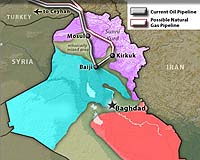 Iraq upgrades its oil export pipelines
| The content herein, unless otherwise known to be public domain, are Copyright 1995-2010 - SpaceDaily. AFP and UPI Wire Stories are copyright Agence France-Presse and United Press International. ESA Portal Reports are copyright European Space Agency. All NASA sourced material is public domain. Additional copyrights may apply in whole or part to other bona fide parties. Advertising does not imply endorsement,agreement or approval of any opinions, statements or information provided by SpaceDaily on any Web page published or hosted by SpaceDaily. Privacy Statement |


