|
 |
 |
 |
 |
 |
 |
 |
 |

 |
Initial Tests Completed On Stryker NBCRV
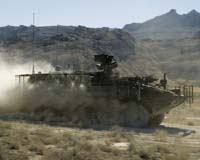
Dugway Proving Grounds, UT (AFNS) (SPX) Jan 02, 2007 Initial operating tests were completed on the Stryker Nuclear, Biological and Chemical Reconnaissance Vehicle at Dugway Proving Grounds in late 2006. The Stryker NBCRV will detect and identify biological, chemical, radiological and toxic industrial chemical/material hazards on the battlefield, according to Maj. Joseph Giese, test officer for the Engineer and Combat Support Test Directorate. The vehicle provides ballistic protection to a crew of four. In addition, the driver, vehicle commander and two surveyors are protected by a positive overpressure system that allows them to wear limited protective gear while operating on contaminated battlefield for extended periods of time. Forty-four members of the 4th Brigade, 2nd Infantry Division, I Corps, from Fort Lewis, Wash., participated in the test under the direction of ECSTD. ECSTD is part of the U.S. Army Operational Test Command, West Fort Hood, Texas. The Soldiers prepared for the test with 10 weeks of crew training at Yakima, Wash., last March. "The intent of the evaluation was to examine the ability of the Stryker NBCRV to survive and perform reconnaissance and surveillance missions in a variety of threat environments," said Giese. "Test players executed route, area and zone reconnaissance, and search and survey missions to detect, identify, locate, sample and mark the various threats." Testers were looking at the ability of the Stryker NBCRV to perform missions under battlefield conditions in the presence of non-ballistics threats, to use its vehicular collective protection capability, and to not endanger the crew or nearby forces by unreasonable exposure to enemy observation, Giese said. There were more than 200 support personnel on site for the test, said Sgt. 1st Class Mark Sury, ECSTD research, development, test and evaluation NCOIC. "TESCO (Test Support Contractor) provided instrumentation for data collection and analysis," he said. "We conducted a 72-hour scenario pilot test and two 216-hour scenario record tests." The NBCRV is one of 10 Stryker platforms produced by General Dynamics Land Systems Corporation. Powered by a 350 horsepower diesel engine produced by Caterpillar, the Stryker NBCRV has eight run-flat tires, a Central Tire Inflation System and a Height Management System, allowing it to traverse the harshest terrain. The Stryker NBCRV is equipped with a remote weapons station that supports the M2.50-caliber machine gun, an M6 smoke grenade launcher and an integrated thermal weapons sight. It also hosts the common Stryker communications suite. The suite integrates the Single-Channel Ground-to-Air Radio System, the Enhanced Position Location Reporting System, the Force XXI Battle Command Brigade and Below System and the Global Positioning System. "The NBCRV will allow commanders to shape the battlefield by developing and providing NBC situational awareness," said Giese, "and contributing to the common operational picture, specific to NBC contamination." "Most importantly," Giese said, "it provides an element of NBC force protection to the maneuver force." "A system of systems, the Stryker NBCRV represents a significant improvement to existing NBC reconnaissance and surveillance systems within the Army," said Sury. Improvements over the battle-proven M93A1 FOX NBC Reconnaissance System include on-the-move standoff chemical detection capability, biological-detection capability, on-the-move meteorological system capability, and electronic-mapping capability, he explained. "The mission of Dugway is to test U.S. and Allied biological and chemical defense systems and perform nuclear-biological-chemical survivable testing of defense material," said Sury. "Different types of chemical and biological simulates were released into the various training areas, and after each mission where a simulate release occurred, the Stryker NBCRVs were required to undergo an operational decon prior to continuing the mission." The test was conducted at Dugway Proving Grounds, located 80 miles west-southwest of Salt Lake City, Utah, because it provided the perfect testing environment, said Sury." Community Email This Article Comment On This Article Related Links The latest in Military Technology for the 21st century at SpaceWar.com The latest in Military Technology for the 21st century at SpaceWar.com
 New Evaluation Brigade To Test Emerging Warfighter Technologies
 Fort Bliss TX (AFNS) Jan 02, 2007
A new brigade here will test some of the most revolutionary concepts and systems being developed for future warfighters, report how they operate under field conditions, and ultimately speed their fielding to troops on the battlefield. The new Evaluation Brigade Combat Team being stood up here will test 18 major systems being developed for the Army's Future Combat Systems program, explained Col. Michael Wadsworth, chief of training and leader development for the Future Force Integration Directorate here. |
|
|

| The content herein, unless otherwise known to be public domain, are Copyright 1995-2006 - SpaceDaily.AFP and UPI Wire Stories are copyright Agence France-Presse and United Press International. ESA PortalReports are copyright European Space Agency. All NASA sourced material is public domain. Additionalcopyrights may apply in whole or part to other bona fide parties. Advertising does not imply endorsement,agreement or approval of any opinions, statements or information provided by SpaceDaily on any Web page published or hosted by SpaceDaily. Privacy Statement |