|
 |
 |
 |
 |
 |
 |
 |
 |

 |
Indonesia Hopes To See Haze Lift Within Two Years
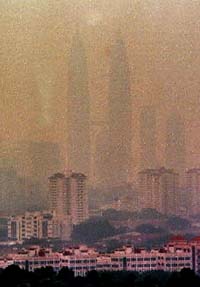
Jakarta (AFP) Dec 04, 2006 Indonesia hopes to see a major improvement in the annual problem of choking haze within the next two years after introducing tough new methods to tackle the problem, Environment Minister Rachmat Witoelar said on Monday. Witoelar said police could now seize land hit by suspicious fires and the ministry would also work to raise the water levels in peat areas to reduce the chance of blazes. Indonesian farmers burn forests and shrubland annually to clear land for agriculture, causing a choking haze that spreads across Southeast Asia during the dry season, affecting tourism and health in the region. Witoelar said police would confiscate any land which was burned and would prevent plantation owners from illegally expanding their holdings. "The government has created an initiative where we will now hold responsible any plantation owners where there is fire, whether they started it or not," he told a Jakarta Foreign Correspondents' Club lunch. "If there are any burnings and we cannot get to the bottom of it, we will confiscate the land and put a police line there and that cannot be cultivated. So there will be no motive for anyone to consciously burn the land," he said. He said the "policy has yielded results" since it was introduced in August, pointing to Riau province, opposite Singapore, where "the hotspots have been reduced very drastically" even before the start of the rainy season. "We are taking hostage any area that has been burnt in our efforts to find out who did it. If it cannot be proven conclusively, we will hold it hostage because then we will dare the owners to sue me if we are not right," the minister said. Deep-seated peat fires could not be tackled by aerial spraying, so the ministry was planning to damn irrigation channels and ditches to raise the water levels in affected areas so the peat would not burn so readily. "We expect to have a decrease of 30 to 40 percent of happenings (fires started) there, which I think will cut down on the total size of the burnings we've experienced in previous years," he said. Despite the new measures, the minister, who took office in 2004, said he would need another two years to tackle a problem, which dates back 30 years. "To stop a running train after 30 years in four years I think is reasonable," he said. "I beg for time because this problem is so difficult, it took 20 to 30 years (to develop). Every year it happens all over again. It happened last year, it happened this year, it will probably also happen next year, but after that I hope it will be stopped," he said. Indonesia has yet to ratify a regional treaty on preventing haze, but Witoelar said that did not mean the government was doing nothing while waiting for parliament to act. "I was also wondering why they are kind of hesitating, because it was me that handed over the document and said 'please ratify this', and I've been waiting as well as you," he told reporters at the lunch. "It does not reflect on our national effort" in fighting the problem, he said. The Association of Southeast Asian Nations (ASEAN) forged an Agreement on Transboundary Haze Pollution in Kuala Lumpur, Malaysia on June 10, 2002, but Indonesia and the Philippines have yet to ratify the treaty. The haze hit its worst level in 1997-98 and cost the Southeast Asian region an estimated nine billion dollars by disrupting air travel and other business activities.
Source: Agence France-Presse Community Email This Article Comment On This Article Related Links Our Polluted World and Cleaning It Up Our Polluted World and Cleaning It Up
 Reducing Air Pollution Could Increase Rice Harvests In India
 Berkeley CA (SPX) Dec 05, 2006
New research from the University of California indicates that reductions of human-generated air pollution could create unexpected agricultural benefits in one of the world's poorest regions. These new findings will be published online the week of Dec. 4 in the journal Proceedings of the National Academy of Sciences (PNAS). |
|
|

| The content herein, unless otherwise known to be public domain, are Copyright 1995-2006 - SpaceDaily.AFP and UPI Wire Stories are copyright Agence France-Presse and United Press International. ESA PortalReports are copyright European Space Agency. All NASA sourced material is public domain. Additionalcopyrights may apply in whole or part to other bona fide parties. Advertising does not imply endorsement,agreement or approval of any opinions, statements or information provided by SpaceDaily on any Web page published or hosted by SpaceDaily. Privacy Statement |