|
 |
 |
 |
 |
 |
 |
 |
 |

 |
India To Launch Submarine Production
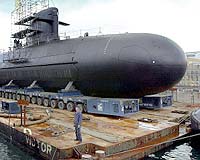
Mumbai (AFP) Dec 12, 2006 India is to begin assembling Franco-Spanish Scorpene attack submarines this week as part of plan to boost its naval power and military-industrial know-how. Indian navy Vice Admiral S.K.K. Krishnan, the head of Mumbai's Mazagaon Dock naval shipyard, said production would begin on Thursday, with a formal opening ceremony attended by Prime Minister Manmohan Singh to be held at a later date. The 2.4 billion euro deal to build an initial six diesel submarines was signed in October 2005 with Armaris, a subsidiary of France's Thales group and Direction des Constructions Navales (DCN). The agreement also includes the sale of 36 Exocet-type anti-submarine and anti-ship missiles. "As far as the production is concerned, nothing has changed. We are technically ready. Production will be starting on Thursday," Krishnan told AFP. "This is only phase one. We plan to build 18 more indigenous submarines," he said. The Scorpene, jointly developed by DCN and Spain's Navantia, is a 67-metre-long (220 feet) craft designed for attack and interception. Malaysia and Chile have also placed orders. India's contract covers a 12-year period, and the first craft is scheduled to enter into service in 2012, with an additional submarine following each year. India's navy currently has 16 submarines, but these are mainly ageing Russian and German models. With the Scorpene, India is hoping to bring its fleet up to date to match challenges from rivals Pakistan and China. The contract also includes the transfer of key technology, with just the first two submarines being built under French and Spanish supervision. The arrangement has been presented as a win-win deal giving new technology to India and a major foothold in the country's huge defence market to the foreign firms. "It's an innovative technology transfer, with the indigenisation of sub-systems, equipment and components," said Amaris' project director Xavier Marchal. "In the future there will be good deals to be made in India. This serves as a foundation for DCN's industrial relations at a moment when India's defence economy is transforming," he said. India is the largest arms purchaser among emerging nations and said last month that it will not prune defence spending because of the growing threat from terrorism and ongoing regional tensions. India annually spends 14 billion dollars, or 2.34 percent of its gross domestic product, on its military. Since 2004 it has either spent or committed billions of dollars in modernisation projects planned until 2010. But the Scorpene deal has been marred by corruption allegations. The main opposition party, the Hindu nationalist Bharatiya Janata Party (BJP), alleged that around four percent of the contract amount -- or around 100 million dollars -- was paid to Indian intermediaries, one of whom is said to be close to the ruling Congress party. The charges came after weekly magazine Outlook published a series of articles alleging that French defence giant Thales paid the commission to Indian middlemen to clinch the deal. Thales as well as the French and Indian governments have denied the allegations.
Source: Agence France-Presse Community Email This Article Comment On This Article Related Links Naval Warfare in the 21st Century Learn about nuclear weapons doctrine and defense at SpaceWar.com Naval Warfare in the 21st Century
 Squid-Inspired Design Could Mean Better Handling Of Underwater Vehicles
 Boulder CO (SPX) Dec 14, 2006
Inspired by the sleek and efficient propulsion of squid, jellyfish and other cephalopods, a University of Colorado at Boulder researcher has designed a new generation of compact vortex generators that could make it easier for scientists to maneuver and dock underwater vehicles at low speeds and with greater precision. |
|
|

| The content herein, unless otherwise known to be public domain, are Copyright 1995-2006 - SpaceDaily.AFP and UPI Wire Stories are copyright Agence France-Presse and United Press International. ESA PortalReports are copyright European Space Agency. All NASA sourced material is public domain. Additionalcopyrights may apply in whole or part to other bona fide parties. Advertising does not imply endorsement,agreement or approval of any opinions, statements or information provided by SpaceDaily on any Web page published or hosted by SpaceDaily. Privacy Statement |