|
 |
 |
 |
 |
 |
 |
 |
 |

 |
Squid-Inspired Design Could Mean Better Handling Of Underwater Vehicles
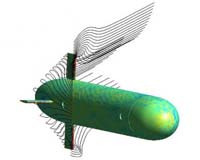
Boulder CO (SPX) Dec 14, 2006 Inspired by the sleek and efficient propulsion of squid, jellyfish and other cephalopods, a University of Colorado at Boulder researcher has designed a new generation of compact vortex generators that could make it easier for scientists to maneuver and dock underwater vehicles at low speeds and with greater precision. In addition, the technology - seemingly inspired by the plots of two classic sci-fi films - may soon allow doctors to guide tiny capsules with jet thrusters through the human digestive tract, enabling them to diagnose disease and dispense medications. Kamran Mohseni, an assistant professor of aerospace engineering sciences, will present these and other details at the American Geophysical Union's annual fall meeting Dec. 11-15 in San Francisco. A global network of scientists, the AGU describes its mission as the advancement of terrestrial, atmospheric and space research aimed at benefiting humanity. "Reliable docking mechanisms are essential for the operation of underwater vehicles, especially in harsh environments," Mohseni said. "We set out to resolve the trade off that many researchers settle for, which is a faster, but less precise, vehicle or a boxier one that is not as fast and more difficult to transport to work locations." Manned and unmanned underwater vehicles enable scientific researchers to explore ecosystems around the globe, from undersea volcanoes near Hawaii to the frigid depths beneath pack ice in the North and South poles. However, while the torpedo shape of some underwater vehicles ensures rapid deployment and high cruising speeds with minimal energy, their hydrodynamic design makes them more difficult to maneuver or dock at low speeds and in tight spaces, or to hover in precise locations. Underwater craft with boxier designs are easier to dock and maneuver, but speed is sacrificed in the process. The vortex thrusters designed by CU-Boulder researchers offer speed with versatility and may enable researchers to explore previously inaccessible places. Currently, many designers are trying to devise better docking systems for underwater vehicles, but Mohseni said he and his collaborators wanted to improve the watercrafts' actual maneuvering capabilities. "We didn't want to treat the symptom alone," he said. "We made it our goal to resolve a widespread problem." Mohseni created his new generators after studying the formation of vortex rings, much like those formed by squid and jellyfish to move themselves underwater. Vortex rings are formed when a burst of fluid shoots out of an opening, moving in one direction and spreading out as it curls back. The researcher's nature-inspired vortex generators could be used in a wide array of applications. One of them, a seeming take-off of technology featured in the sci-fi cult classics "Fantastic Voyage" and "Innerspace," employs tiny capsules that could travel through the human digestive tract to diagnose and treat diseases and disperse medications. To date, Mohseni and his collaborators in the CU-Boulder aerospace engineering department have designed and tested three separate unmanned underwater vehicles. With the latest model, the team successfully conducted a parallel parking test. The team also has designed a series of other micro vehicles for air and underwater use. A National Science Foundation grant is funding their research. Community Email This Article Comment On This Article Related Links University of Colorado at Boulder Cephalopod-Inspired Compact Vortex Generators Naval Warfare in the 21st Century
 General Dynamics Awarded $208M For Second Trimaran Littoral Combat Ship
 Bath MN (SPX) Dec 12, 2006
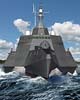
The U.S. Navy has awarded a $208 million contract option to a Bath Iron Works-led team for construction of a second Littoral Combat Ship (LCS) featuring an innovative, high-speed trimaran hull. The 127-meter surface combatant ship, equipped with open architecture-based combat systems and computing environment, is scheduled for delivery to the Navy in July 2009. The original contract was awarded in July 2003. |
|
|

| The content herein, unless otherwise known to be public domain, are Copyright 1995-2006 - SpaceDaily.AFP and UPI Wire Stories are copyright Agence France-Presse and United Press International. ESA PortalReports are copyright European Space Agency. All NASA sourced material is public domain. Additionalcopyrights may apply in whole or part to other bona fide parties. Advertising does not imply endorsement,agreement or approval of any opinions, statements or information provided by SpaceDaily on any Web page published or hosted by SpaceDaily. Privacy Statement |