|
 |
 |
 |
 |
 |
 |
 |
 |

 |
India Looks To China, Not Just U.S.
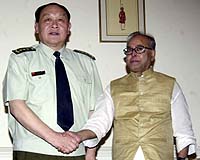
Washington (UPI) May 27, 2005 The warm and successful visit of China's top military officer to New Delhi last week has confirmed the lesson of the F-16s sale to Pakistan: India under its Congress government puts detente with China above partnership with America. India and China are going to increase their confidence-building measures across their border. Visiting Chinese army chief Gen. Liang Guanglie made the proposals in his meetings with Indian leaders and security chiefs Wednesday and they were believed to include an increase in military-to-military exchanges. "The defense minister shared his (Liang's) view that the two sides and armed forces must work to promote peace and tranquility on the border and promote stability and development in Asia," an Indian defense ministry spokesman said. On Thursday, the head of the Indian army announced that the armies of both giant nations were going to hold unprecedented joint counter-terrorism and peacekeeping training programs. Gen. Joginder Jaswant Singh said the plans had been discussed with Gen. Liang. He said that border tensions between the two countries had eased so much that young soldiers from both armies were already going on joint mountaineering expeditions, playing volleyball matches and even and sharing meals on their inaccessible Himalayan joint border area. "The momentum given by the leaders of our two countries is being enhanced further by the two militaries," Singh told reporters. "On the roadmap of military-to-military cooperation in the future (are) exercises where both countries could carry out together to counter terrorism or on UN missions," he said. Also on Wednesday, India offered to hold a second round of naval exercises with China off the Indian coast. Adm. Arun Prakash, chairman of India's Chiefs of Staff Committee and naval chief, made the offer to Gen. Liang who expressed his support for the idea, according to a Press Trust of India report. The two countries' navies held a joint exercise off the Shanghai coast in November 2003. Indian military observers were also invited to witness Chinese People's Liberation Army exercises in 2004. Liang further met Wednesday with Indian Defense Minister Pranab Mukherjee and expressed optimism on the progress of talks to solve the vexed boundary issue between the two countries. He also met with National Security Adviser M K Narayanan. Liang's six-day visit was the first by a Chinese armed forces chief of staff to India in seven years. It followed the April visit of Chinese Prime Minister Wen Jiabao. India-China relations have been warming over the past two years since even before Congress shocked the world by unexpectedly and decisively routing the pro-American Hindu nationalist led government of former Prime Minister Atal Bihari Vajpayee and his Bharatiya Janata Party. The two countries had already signed cooperation documents during the visit to China of former Indian Army chief Gen. N.C. Vij in December, and they held joint naval exercises in November 2003. Beijing invited the Indian Army to observe military exercises in China last September. The warmth of Gen. Liang's visit contrasted with the fury of India's leaders in March when President George W. Bush revealed to Prime Minister Manmohan Singh that he had approved selling 70 nuclear-capable F-16 fighter-bombers to India's arch-enemy, neighboring Pakistan. The F-16s may well significantly shift the air balance of power in Pakistan's favor as they have far more advanced electronics than India's Russian supplied Sukhoi interceptors. The Indians also noted that the Bush administration has extended its current generous aid levels to Pakistan of $3 billion year until 2009, with no time cap at the end so that they can be indefinitely renewed. And the just-approved "9/11 Recommendations Implementation Act" includes a waiver on all remaining U.S. sanctions on Pakistan for the next two years. India's leaders are concerned that the new wave of U.S. largesse to Pakistan will embolden Pakistan's shrewd and tough President Pervez Musharraf and possibly encourage him to take a tougher, less conciliatory line toward New Delhi. However, ultimately, it is the Bush administration's cornucopia of financial support and state of the art weapons to Pakistan that is the main cause for the souring of the U.S.-India honeymoon. If senior U.S. officials wanted to reassure Singh's Congress-led government they were a different breed from the old Nixon and Reagan teams that dumped India to court Pakistan, they have signally failed to do so. Strategic engagement between the United States and India is still far from dead. Bush administration leaders remain enamored of the idea and India has a lot to gain from enjoying increased access to world leading U.S. military technology. In particular, New Delhi has welcomed U.S. ioffers to sell F-18s for its future expanded carrier fleet in the Indian Ocean as well as for its land-based air force. The F-18s would be a massive improvement on India's aging Russian-supplied interceptors, with their inferior electronic equipment and often-troublesome lack of sufficient spare parts. However, Gen. Liang's productive visit serves notice to Washington that the Congress government is determined to improve ties with China, not confront it. And far from joining the United States in some strategic alliance or understanding to surround and contain China, the current Indian government looks set to dramatically further upgrade ties with its northern neighbor, freeing China to concentrate its forces and strategic concerns on the possibility of eventually having to confront the United States over Taiwan. Community Email This Article Comment On This Article Related Links SpaceDaily Search SpaceDaily Subscribe To SpaceDaily Express
 ISRO To Partner With EADS Astrium
 Bangalore, India (SPX) Jan 11, 2006
Seeking to position India as a cost-effective destination for satellite-building and commercial launch services, Indian Space Research Organisation has forged partnerships with France-based 'EADS Astrium' and European space consortium Arianespace, reports PTI. |
|
|

| The content herein, unless otherwise known to be public domain, are Copyright 1995-2006 - SpaceDaily.AFP and UPI Wire Stories are copyright Agence France-Presse and United Press International. ESA PortalReports are copyright European Space Agency. All NASA sourced material is public domain. Additionalcopyrights may apply in whole or part to other bona fide parties. Advertising does not imply endorsement,agreement or approval of any opinions, statements or information provided by SpaceDaily on any Web page published or hosted by SpaceDaily. Privacy Statement |