|
 |
 |
 |
 |
 |
 |
 |
 |

 |
ISS Orbit To Be Adjusted After Failed Attempt
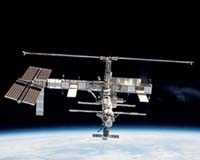
Moscow (RIA Novosti) Dec 01, 2006 The Russian Space Agency said the orbit of the International Space Station (ISS) would be adjusted following Thursday's abortive correction, before the docking of a U.S. space shuttle. Russia's Mission Control Center said earlier Thursday it had failed to correct the ISS orbit due to an engine malfunction. "A decision has been made to repeat the orbit correction on December 2," the agency's press secretary Igor Panarin said. "We believe nothing will hinder the docking with a U.S. space shuttle in December." The orbit correction was planned as part of preparations for the docking of a U.S. space shuttle scheduled to lift off on December 7 and a Russian Progress M-59 cargo vehicle, whose launch has been set for January 2007. A mission control official said it was originally planned to raise the ISS orbit by 7.3 kilometers (4.5 miles), but now it remains unclear how much the orbit changed after the abortive correction attempt. "The orbit correction has been aborted after the engines of the Progress M-55 cargo vehicle worked for 78 seconds instead of 1,102 seconds and failed to achieve the profile thrust mode," he said. The official also said the causes of the malfunction would be established sometime in the afternoon after all data was processed. "We will establish the causes of the correction failure later today," he said. A similar incident occurred during ISS correction maneuvers in October 2005, when they were aborted after a system engine shutoff of the Progress M-55 cargo vehicle hampered the mission control's attempt to raise the station's orbit by 10 km (about 6 miles) to maintain working orbital parameters.
earlier related report The orbit correction was planned as part of preparations for the docking of a U.S. space shuttle scheduled to lift off on December 7 and a Russian Progress M-59 cargo vehicle, whose launch has been set for January 2007. "The orbit correction has been aborted after the engines of the Progress M-55 cargo vehicle worked for 78 seconds instead of 1,102 seconds and failed to achieve the profile thrust mode," a mission control official said. He said the mission control originally planned to raise the ISS orbit by 7.3 kilometers (4.5 miles), but it was not clear how much the orbit changed after the abortive correction attempt. The official also said the causes of the malfunction would be established sometime in the afternoon after all data was processed. "We will establish the causes of the correction failure later today," he said. A similar incident occurred during ISS correction maneuvers in October 2005, when they were aborted after a system engine shutoff of the Progress M-55 cargo vehicle hampered the mission control's attempt to raise the station's orbit by 10 km (about 6 miles) to maintain working orbital parameters.
Source: RIA Novosti
earlier related report The American shuttle is preparing to transport a new 11-million-dollar truss segment for the ISS, to be installed during a spacewalk. "The engines of the Progress spacecraft failed to operate for the required duration. As a result, the ISS orbit was raised by 1.5 kilometers (one mile) instead of seven kilometers (4.5 miles)," an official at Russia's mission control told Interfax. It is not yet clear what caused the engines to fail, the spokesman said. The operation to raise the station's orbit was designed to allow Discovery to dock with the station following its planned launch on December 7. The last operation to raise the station's orbit took place at the end of August to counteract the fact that the station's orbit drops by 150-200 meters per day, ITAR-TASS reported. Two other spacewalks are planned to rewire the space station, switching the temporary electricity system to a permanent one.
Source: Agence France-Presse Community Email This Article Comment On This Article Related Links Roscosmos Space Station News at Space-Travel.Com Space Station News at Space-Travel.Com
 ESA's First Swedish Astronaut To Fly To The ISS
 Paris, France (ESA) Dec 01, 2006
ESA astronaut Christer Fuglesang is about to become the first Swedish and the first Nordic astronaut in space. During the night of 7/8 December, he will board NASA's Shuttle Discovery as Mission Specialist on flight STS-116. With his six crewmates, he will fly to the International Space Station on a mission to add a new section to its truss structure and to reroute electrical power supply and thermal control from its new set of solar arrays and radiators. |
|
|

| The content herein, unless otherwise known to be public domain, are Copyright 1995-2006 - SpaceDaily.AFP and UPI Wire Stories are copyright Agence France-Presse and United Press International. ESA PortalReports are copyright European Space Agency. All NASA sourced material is public domain. Additionalcopyrights may apply in whole or part to other bona fide parties. Advertising does not imply endorsement,agreement or approval of any opinions, statements or information provided by SpaceDaily on any Web page published or hosted by SpaceDaily. Privacy Statement |