|
 |
 |
 |
 |
 |
 |
 |
 |

 |
Hybrid Structures Combine Strengths Of Carbon Nanotubes And Nanowires
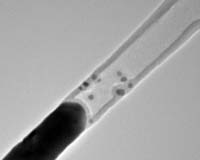
Troy NY (SPX) Jan 09, 2007 A team of researchers at Rensselaer Polytechnic Institute has created hybrid structures that combine the best properties of carbon nanotubes and metal nanowires. The new structures, which are described in a recent issue of Applied Physics Letters, could help overcome some of the key hurdles to using carbon nanotubes in computer chips, displays, sensors, and many other electronic devices. The impressive conductivity of carbon nanotubes makes them promising materials for a wide variety of electronic applications, but techniques to attach individual nanotubes to metal contacts have proven challenging. The new approach allows the precise attachment of carbon nanotubes to individual metal pins, offering a practical solution to the problem of using carbon nanotubes as interconnects and devices in computer chips. "This technique allows us to bridge different pieces of the nanoelectronics puzzle, taking us a step closer to the realization of nanotube-based electronics," said Fung Suong Ou, the paper's corresponding author and a graduate student in materials science and electrical engineering at Rensselaer. As chip designers seek to continually increase computing power, they are looking to shrink the dimensions of chip components to the nanometer scale, or about 1-100 billionths of a meter. Carbon nanotubes and nanowires that became available in the 1990s are promising candidates to act as connections at this scale, according to Ou, because they both possess interesting properties. For example, carbon nanotubes display amazing mechanical strength, and they are excellent conductors of electricity, with the capacity to produce interconnects that are many times faster than current interconnects based on copper. Gold nanowires also have very interesting optical and electrical properties, and they are compatible with biological applications, Ou said. "In order to take full advantage of these materials, we demonstrate the idea of combining them to make the next generation of hybrid nanomaterials," he said. "This approach is a good method to marry the strengths of the two materials." The metal nanowires in this technique are made using an alumina template that can be designed to have pore sizes in the nanometer range. Copper or gold wires are deposited inside the pores, and then the entire assembly is placed in a furnace, where a carbon-rich compound is present. When the furnace is heated to high temperatures, the carbon atoms arrange themselves along the channel wall of the template and the carbon nanotubes grow directly on top of the copper wires. "It's a really easy technique, and it could be applied to a lot of other materials," Ou said. "The most exciting aspect is that it allows you to manipulate and control the junctions between nanotubes and nanowires over several hundred microns of length. The alumina templates are already mass-produced for use in the filter industry, and the technique can be easily scaled up for industrial use." To date the team has made hybrid nanowires that combine carbon nanotubes with both copper and gold. But they also are currently working to connect carbon nanotubes to a semiconductor material, which could be used as a diode, according to Ou. The research was performed under the guidance of Pulickel Ajayan, the Henry Burlage Professor of Materials Science and Engineering at Rensselaer and a world-renowned expert in fabricating nanotube-based materials. Other Rensselaer researchers involved with the project were Robert Vajtai, Derek Benicewicz, Lijie Ci, and M.M. Shaijumon. The research was funded by grants from the National Science Foundation and the Focus Center New York for Electronic Interconnects. Community Email This Article Comment On This Article Related Links Rensselaer Polytechnic Institute Nano Technology News From SpaceMart.com Nano Technology News From SpaceMart.com Computer Chip Architecture, Technology and Manufacture
 Nanotech Safety Measures Need To Be Created
 Washington (UPI) Dec 29, 2006
 Safety experts said more planning is needed to ensure nanotechnology-safe workplaces across the United States in the future. |
|
|

| The content herein, unless otherwise known to be public domain, are Copyright 1995-2006 - SpaceDaily.AFP and UPI Wire Stories are copyright Agence France-Presse and United Press International. ESA PortalReports are copyright European Space Agency. All NASA sourced material is public domain. Additionalcopyrights may apply in whole or part to other bona fide parties. Advertising does not imply endorsement,agreement or approval of any opinions, statements or information provided by SpaceDaily on any Web page published or hosted by SpaceDaily. Privacy Statement |