|
 |
 |
 |
 |
 |
 |
 |
 |

 |
Hurtling Toward Mars
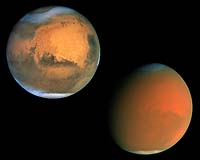
for Science at NASA Huntsville AL (MSFC) Aug 22, 2007 Earth and Mars are converging, and right now the distance between the two planets is shrinking at a rate of 22,000 mph--or about 25 miles per sentence. Ultimately, this will lead to a close approach in late December 2007 when Mars will outshine every star in the night sky. Of a similar encounter in the 19th century, astronomer Percival Lowell wrote the following: "[Mars] blazes forth against the dark background of space with a splendor that outshines Sirius and rivals the giant Jupiter himself." Contrary to rumor, though, Mars is never going to outshine the Moon. There is an email circulating the internet-called the "Mars Hoax" or the "Two Moons email"-claiming that Mars will soon swell as large as the full Moon, and the two will hang together side by side on the night of Aug. 27th. "Mars will be spectacular," it states. "No one alive today will ever see this again." No one will see it, because it won't happen. It is true that Earth and Mars are converging--you're now 300 miles closer--but even at closest approach the two planets are separated by a gulf of tens of millions of miles. From such a distance, Mars looks like a star, an intense yet tiny pinprick of light, never a full Moon. To appreciate the situation, think of Earth and Mars as runners on a track, with speedy Earth on the inside lane and slower Mars on the outside: diagram. Now, in August, Earth is catching up to Mars from behind. Relative speed: 22,000 mph. In December, Earth overtakes Mars, still moving rapidly but never approaching the Red Planet any nearer than the gap between lanes: about 55 million miles. Mindful that the two planets are converging, NASA chose this time to send its Phoenix Lander to Mars. Launched in June 2007 from Cape Canaveral, Phoenix is slated to land in late May 2008 on a Martian arctic plain where Phoenix's robotic arm will dig in the dirt hunting for, among other things, habitats for microbial life. Only to Phoenix, when it gets very close to Mars next year, will the red planet actually rival the Moon in apparent size. So ... you should forget about Mars on August 27th, right? Not so fast. While there won't be Two Moons on August 27th, there will be Two Eyes. At 3 o'clock in the morning on that date, Mars will rise in the eastern sky alongside the red giant star Aldebaran. The two red lights side-by-side will resemble two eerie, unblinking eyes. This is worth waking up for! If you've been following the adventures of Spirit and Opportunity, you know that Mars is currently experiencing a planet-wide dust storm. Rust-colored dust is choking the air and dimming sunlight, causing problems for the two solar-powered rovers. During the past month, they've had to "stand-down"-no roving or digging or even communicating with Earth at times-in order to conserve power. A backyard telescope pointed at Mars on August 27th may reveal vast clouds of dust partially eclipsing some of the planet's familiar surface markings. Or it may reveal a totally orange ball-that's what Mars looks like when the dust storm kicks into high gear. Take a look; every night the view improves. You're now 1000 miles closer to the planet Mars. Community Email This Article Comment On This Article Related Links Mars News and Information at MarsDaily.com Lunar Dreams and more
 Dust From Martian Sky Accumulates On Solar Panels
 Pasadena CA (JPL) Aug 22, 2007
Even though the Martian sky above Gusev Crater continued to clear, solar power levels on NASA's Spirit rover remained fairly constant as dust settling from the atmosphere accumulated on top of the solar panels. Activities remained restricted. Measurements of atmospheric opacity, known as Tau, dropped from 3.6 on Martian day, or sol, 1283 (Aug. 12, 2007) to 3.3 on sol 1286 (Aug. 16, 2007), generating power levels of 301 watt-hours (100 watt-hours is the amount of energy needed to light a 100-watt bulb for one hour). |
|
|

| The content herein, unless otherwise known to be public domain, are Copyright 1995-2007 - SpaceDaily.AFP and UPI Wire Stories are copyright Agence France-Presse and United Press International. ESA Portal Reports are copyright European Space Agency. All NASA sourced material is public domain. Additional copyrights may apply in whole or part to other bona fide parties. Advertising does not imply endorsement,agreement or approval of any opinions, statements or information provided by SpaceDaily on any Web page published or hosted by SpaceDaily. Privacy Statement |