|
 |
 |
 |
 |
 |
 |
 |
 |

 |
Hubble Zeroes In On Nearest Known Exoplanet
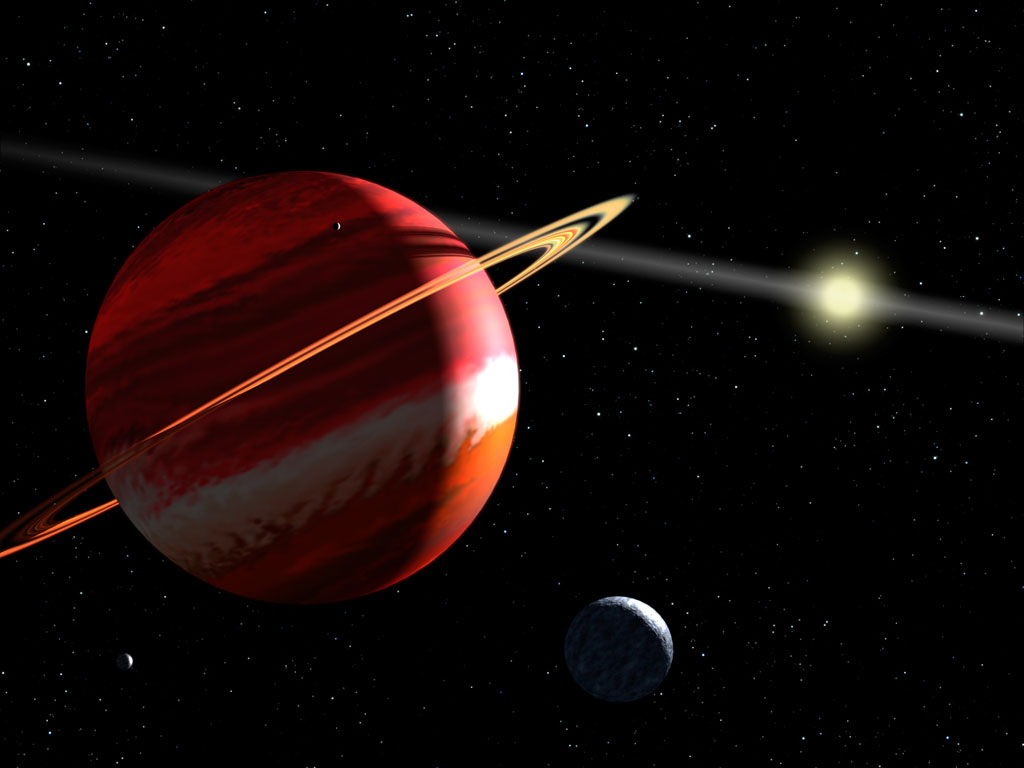
Baltimore MD (SPX) Oct 10, 2006 NASA's Hubble Space Telescope, in collaboration with ground-based observatories, has provided definitive evidence for the existence of the nearest extrasolar planet to our solar system. The Jupiter-sized world orbits the Sun-like star Epsilon Eridani, which is only 10.5 light-years away (approximately 63 trillion miles). The planet is so close it may be observable by Hubble and large ground-based telescopes in late 2007, when the planet makes its closest approach to Epsilon Eridani during its 6.9-year orbit. The Hubble observations were achieved by a team led by G. Fritz Benedict and Barbara E. McArthur of the University of Texas at Austin. The observations reveal the the planet's true mass, which the team has calculated to be 1.5 times Jupiter's mass. Hubble also found that the planet's orbit is tilted 30 degrees to our line of sight, which is the same inclination as a disk of dust and gas that also encircles Epsilon Eridani. This is a particularly exciting result because, although it has long been inferred that planets form from such disks, this is the first time that the two objects have been observed around the same star. The research team emphasized that the alignment of the planet's orbit with the dust disk provides compelling direct evidence that planets form from disks of gas and dust debris around stars. The planets in our Solar System share a common alignment, evidence that they were created at the same time in the Sun's disk. But the Sun is a middle-aged star - 4.5 billion years old - and its debris disk dissipated long ago. Epsilon Eridani, however, still retains its disk because it is young, only 800 million years old. McArthur originally detected the planet in 2000 by measurements that were interpreted as a rhythmic, back-and-forth wobble in Epsilon Eridani caused by the gravitational tug of an unseen planet. However some astronomers wondered if in fact the turbulent motion of the young star's atmosphere was mimicking the effects of the star being nudged by a planet's gravitational pull. The Hubble observations settle any uncertainty. The Benedict-McArthur team calculated the planet's mass and its orbit by making extremely precise measurements of subtle changes in the star's location in the sky, a technique called astrometry. The slight variations are unmistakably caused by the gravitational tug of the unseen companion object. Benedict's team studied over a thousand astrometric observations from Hubble collected over three years. "You can't see the wobble induced by the planet with the naked eye," Benedict said. "But Hubble's fine guidance sensors are so precise that they can measure the wobble. We basically watched three years of a nearly seven-year-long dance of the star and its invisible partner, the planet, around their orbits. The fine guidance sensors measured a tiny change in the star's position, equivalent to the width of a quarter 750 miles away." The astronomers combined these data with other astrometric observations made at the University of Pittsburgh's Allegheny Observatory. They then added those measurements to hundreds of ground-based radial-velocity measurements made over the past 25 years at McDonald Observatory at the University of Texas, Lick Observatory at the University of California Observatories, the Canada-France-Hawaii Telescope in Hawaii, and the European Southern Observatory in Chile. This combination allowed them to accurately determine the planet's mass by deducing the tilt of its orbit. Although Hubble and other telescopes cannot image the gas giant planet now, they may be able to snap pictures of it in 2007, when its orbit is closest to Epsilon Eridani. The planet may be bright enough in reflected starlight to be imaged by Hubble, other space-based cameras, and large ground-based telescopes. The results will appear in the November issue of the Astronomical Journal. Community Email This Article Comment On This Article Related Links Stellar Chemistry, The Universe And All Within It Space Telescope News and Technology at Skynightly.com
 Astronomers Unite To Use Hawaii Telescope
 Honolulu, Hawaii (SPX) Oct 05, 2006
Astronomers from several major research institutions around the world have signed an agreement with astronomers at the University of Hawaii to make use of a revolutionary new survey telescope on Haleakala on the island of Maui. |
|
|

| The content herein, unless otherwise known to be public domain, are Copyright 1995-2006 - SpaceDaily.AFP and UPI Wire Stories are copyright Agence France-Presse and United Press International. ESA PortalReports are copyright European Space Agency. All NASA sourced material is public domain. Additionalcopyrights may apply in whole or part to other bona fide parties. Advertising does not imply endorsement,agreement or approval of any opinions, statements or information provided by SpaceDaily on any Web page published or hosted by SpaceDaily. Privacy Statement |