|
 |
 |
 |
 |
 |
 |
 |
 |

 |
Hubble Advanced Camera Back In Business
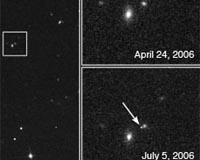
Greenbelt MD (SPX) Jul 14, 2006 After a brief hiatus, the Advanced Camera for Surveys aboard the Hubble Space Telescope is back in full operation, NASA announced Thursday. The instrument is now involved in a quest to understand the nature of the universe's most dominant but mysterious constituent: dark energy. Discovered in 1998, dark energy seems to percolate out of empty space and provides a repulsive force that is causing the universe to expand at an ever-faster rate. This is one of the first images taken after the ACS camera resumed science operation on July 4. The camera remained offline for nearly two weeks as NASA engineers switched to a backup power supply after the camera's primary power supply failed. The picture on the left is of a rich galaxy field containing a distant galaxy cluster 9-billion light-years away (at redshift 1.4). In a program conducted by Saul Perlmutter of the University of California, Berkeley, Hubble periodically revisits about 20 distant galaxy clusters in an attempt to capture the glow of a class of exploding star called a Type Ia supernova. Astronomers have directed Hubble to study the clusters because they could reveal the effects of dark energy at a distance too great to be observed easily from the ground. Type Ia supernovae are bright celestial distance markers that are considered invaluable for measuring how dark energy is influencing the universe. Ultimately, detailed observations like this will allow astrophysicists to understand the nature of dark energy and its influence on the future evolution of the universe more clearly. When Hubble scanned this field in April 2006, (upper right) the area was dark, but when the telescope revisited the sky coordinates in June 2006, looking at a galaxy about 1-billion light-years closer (redshift 1.2), the supernova appeared. So, right after ground controllers successfully returned the ACS to operation, they aimed Hubble at the field again to measure the fading stellar explosion (arrow lower right). The bright core of the host galaxy is adjacent to the glowing supernova, which can briefly become as bright as an entire galaxy of stars. The quality of the April and July images demonstrate that the ACS is operating perfectly and sending back detailed views of the distant universe, NASA controllers said in a news release. Community Email This Article Comment On This Article Related Links Hubble at NASA Hubble home Space Telescope News and Technology at Skynightly.com
 New MIT Telescope To Probe Early Universe
 Cambridge MA (SPX) Jul 11, 2006
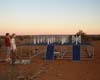
A novel telescope to aid the understanding of the early universe is moving closer to full-scale construction, thanks to a $4.9 million award from the National Science Foundation to a U.S. consortium led by MIT. |
|
|

| The content herein, unless otherwise known to be public domain, are Copyright 1995-2006 - SpaceDaily.AFP and UPI Wire Stories are copyright Agence France-Presse and United Press International. ESA PortalReports are copyright European Space Agency. All NASA sourced material is public domain. Additionalcopyrights may apply in whole or part to other bona fide parties. Advertising does not imply endorsement,agreement or approval of any opinions, statements or information provided by SpaceDaily on any Web page published or hosted by SpaceDaily. Privacy Statement |