|
 |
 |
 |
 |
 |
 |
 |
 |

 |
New MIT Telescope To Probe Early Universe
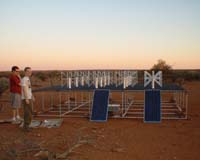
Cambridge MA (SPX) Jul 11, 2006 A novel telescope to aid the understanding of the early universe is moving closer to full-scale construction, thanks to a $4.9 million award from the National Science Foundation to a U.S. consortium led by MIT. The Mileura Widefield Array Low Frequency Demonstrator, currently being built in Australia by the United States and Australian Partners, will allow scientists to predict more accurately the solar bursts of superheated gas that can play havoc with satellites, communication links and power grids. In support of the solar observations, the U.S. Air Force Office of Scientific Research also recently made a $300,000 award to MIT for array equipment. "The design of the new telescope is tightly focused on frontier experiments in astrophysics and heliospheric science. We plan to harness the enormous computing power of modern digital electronic devices, turning thousands of small, simple, cheap antennas into one of the most potent and unique astronomical instruments in the world," said Colin J. Lonsdale, the project's leader at MIT's Haystack Observatory. The LFD will be an array of 500 antenna tiles spread out over an area 1.5 kilometers, or almost a mile, in diameter. Each tile is about 20 feet square and consists of 16 simple and cheap dipole antennas, fixed on the ground and staring straight up. Big conventional telescopes are characterized by huge concave disks that tip and tilt to focus on specific areas of the sky. Thanks to modern digital electronics, the LFD tiles can also be "steered" in any direction - but no moving parts are required. Rather, the signals, or data, from each small antenna are brought together and analyzed by powerful computers. By combining the signals in different ways, the computers can effectively "point" the telescope in different directions. "Modern digital signal processing, enabled by advances in technology, are transforming radio astronomy," said Lincoln J. Greenhill of the Harvard-Smithsonian Center for Astrophysics. This concept has been tested at the proposed Radio Astronomy Park at Mileura in Western Australia with three prototype tiles "lovingly wired together by hand" by MIT and Australian graduate students and researchers, Hewitt said. "The tiles performed very nicely. We were quite pleased with them." The LFD telescope will operate at the same radio wavelengths where FM radio and TV broadcasts are normally found. So if it were sited near a busy metropolis, signals from the latter would swamp the radio whispers from the deep universe. The planned site at Mileura, however, is exceptionally radio quiet and also is highly accessible. LFD collaborators in the United States are the Haystack Observatory, the MIT Kavli Institute for Astrophysics and Space Research and the Harvard-Smithsonian Center for Astrophysics. Australian partners include the CSIRO Australia Telescope National Facility and an Australian university consortium led by the University of Melbourne, including the Australian National University, Curtin University of Technology and others. Community Email This Article Comment On This Article Related Links Radio Astronomy Park Space Telescope News and Technology at Skynightly.com
 New Hawaiian Telescope Dedicated
 Honolulu HI (SPX) Jul 07, 2006
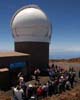
Astronomers dedicated the University of Hawai'i's newest telescope, called PS1, last Friday in a ceremony on the summit of Haleakala, the massive extinct caldera on the island of Mau'i. The telescope is a prototype for the larger Panoramic Survey Telescope and Rapid Response System, or Pan-STARRS, telescope scheduled to start scanning the skies for "killer asteroids" in 2010. |
|
|

| The content herein, unless otherwise known to be public domain, are Copyright 1995-2006 - SpaceDaily.AFP and UPI Wire Stories are copyright Agence France-Presse and United Press International. ESA PortalReports are copyright European Space Agency. All NASA sourced material is public domain. Additionalcopyrights may apply in whole or part to other bona fide parties. Advertising does not imply endorsement,agreement or approval of any opinions, statements or information provided by SpaceDaily on any Web page published or hosted by SpaceDaily. Privacy Statement |