|
 |
 |
 |
 |
 |
 |
 |
 |

 |
How Ants Find Their Way
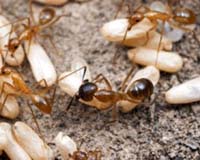
London UK (SPX) Oct 18, 2006 Ever wondered how ants find their way straight to the uncovered food in your kitchen? Now scientists have discovered how the humble wood ant navigates over proportionally huge distances, using just very poor eyesight and confusing and changing natural landmarks. The research could have significant benefits in the development of autonomous robots and in furthering our understanding of basic animal learning processes. Scientists at the University of Sussex, funded by the Biotechnology and Biological Sciences Research Council (BBSRC), have shown precisely how the ant's visual navigation strategy works. On a wood ant's first trip to a food site it follows a chemical trail left by earlier ants. This is a slow way of travelling as the ant needs to walk with its antennae to the ground. However, this initial route forms the basis of an efficient learning strategy. On the first trip ants store images of the route as they travel and on later trips to the food site will navigate using a combination of landmarks and memories of the whole landscape. The scientists found the ants even used different sets of landmark memories depending on whether they were on their way to food, or whether they were full and heading back to the nest. Ants store many memories and have mechanisms to activate the right ones. The researchers refined their research on ant visual memory selection in lab experiments. Research leader, Professor Tom Collett from the University of Sussex's Centre for Neuroscience, explained: "To show that ants use visual memory to navigate we trained ants to find food 10cm from a cylinder. We then doubled the size of the cylinder and the ants searched for the food at 20cm away where the retinal size of the landmark was the same." To analyse the ants' powers of recall an ambiguous situation was set up. Ants were trained to search for food between two cylinders of different sizes and then tested with the training cylinders replaced by two cylinders of the same size. Would ants know which cylinder is which? They were only able to search in the predicted place when a patterned background was introduced as a retrieval cue. Professor Collett said: "To know which cylinder was which ants needed the patterned background to be in a different position on the retina when they faced one or other cylinder. Accurate memory retrieval often relies on ants storing a large panorama." A better understanding of ant navigation could help to develop autonomous robots. Professor Collett explained: "Insect behaviour is much more 'machine-like' than that of mammals, and ants are a lot less flexible in their use of navigational strategies. This stereotypy makes it easier to understand how their strategies operate and to design robots that navigate following similar principles." The researchers are now planning further experiments that will reveal new levels of detail about insect visuo-motor behaviour and allow the construction of models of memory retrieval. Professor Julia Goodfellow, Chief Executive of BBSRC, said: "Cognitive systems research gives us the opportunity to learn more about the ways that animals, including humans, process information to learn, reason, make decisions and communicate. BBSRC is working with other Research Councils and funders to support new interdisciplinary research in this area." Community Email This Article Comment On This Article Related Links Biotechnology and Biological Sciences Research Council Darwin Today At TerraDaily.com Darwin Today At TerraDaily.com
 New Dwarf Buffalo Discovered By Chance In The Philippines
 Chicago IL (SPX) Oct 18, 2006
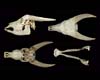
Almost 50 years ago, Michael Armas, a mining engineer from the central Philippines, discovered some fossils in a tunnel he was excavating while exploring for phosphate. Forty years later, Dr. Hamilcar Intengan, a friend of his who now lives in Chicago, recognized the importance of the bones and donated them to The Field Museum. |
|
|

| The content herein, unless otherwise known to be public domain, are Copyright 1995-2006 - SpaceDaily.AFP and UPI Wire Stories are copyright Agence France-Presse and United Press International. ESA PortalReports are copyright European Space Agency. All NASA sourced material is public domain. Additionalcopyrights may apply in whole or part to other bona fide parties. Advertising does not imply endorsement,agreement or approval of any opinions, statements or information provided by SpaceDaily on any Web page published or hosted by SpaceDaily. Privacy Statement |