|
 |
 |
 |
 |
 |
 |
 |
 |

 |
High Energy Scans More Efficient At Ports
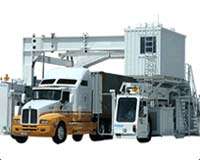
Washington (UPI) Jun 15, 2006 As questions of border and port security remain in the wake of the failed Dubai Ports World deal, a new imaging system could make cargo screening more accurate and able to catch threats such as radioactive or nuclear material. Rapiscan Systems has developed a new high-energy scanner to pinpoint questionable material. The new scanners have better penetration and can more quickly scan large cargo containers. Previously, with backscatter technology, material encompassed in boxes or crates within cargo containers was not fully transparent to older imaging systems. With traditional x-ray scanning techniques similar to those used in hospitals, only 10 to 20 percent of cargo can be visualized, leaving up to 90 percent to be examined manually. Similarly, with gamma technology, only 60 percent can be seen on a scanner. However, with the emerging high-energy transmission scanning systems, between 80 to 95 percent of cargo can be scanned in a matter of seconds, leading to a higher volume of trade items going in and out of U.S. ports more safely. High energy transmission scanning systems can also be equipped with isotope specific technologies to identify radioactive and nuclear materials. Manual inspections, while possibly more thorough, are an inefficient use of time and not plausible with the volume of cargo continually passing through ports. It would take a customs agent 15 hours to manually inspect a freight car, while a scanning device could do the same in roughly 30 seconds. "The benefit with transmission is that you get to know what you don't see. With backscatter there's no image confidence," said Peter Kant, vice president of government affairs for Rapiscan. The Los Angeles-based company presented an overview of their scanning systems at a Capitol Hill briefing Monday. "The better the penetration of the technology, the more cargo can be inspected by the technology and the less by people," Kant said. In the months after Sept. 11, the Container Security Initiative (CSI) was launched by the U.S. Bureau of Customs and Border Protection to evaluate the status of inspections at the nation's ports. But after news broke that the White House had contracted security control of U.S. ports in Baltimore, New York, Newark, Philadelphia, Miami and New Orleans to Dubai Ports World, the issue of port security became a priority in Congress. The United Arab Emirates firm soon backed out of the deal, but the clash nonetheless brought the debate over border and port security to the forefront. In May the House voted 421-2 to allocate $7.4 billion for better port scanners like those made by Rapiscan. Many foresee another terrorist attack not coming from hijacked planes, but instead through dangerous materials illegally brought into the United States, thus making border and port security an absolutely essential facet of homeland security. "Central to our country's defense against terrorist threats is the ability to effectively utilize appropriate technologies to inspect cargo containers and protect U.S. ports of entry," said Sen. Lincoln Chafee (R-R.I.), who sponsored the forum. Even with this new technology, there are no sure guarantees of safety, and a caution must still be exercised by agencies across the board. "There is no silver bullet," said Elaine Dezenski, former Department of Homeland Security acting assistant secretary for policy development. "We're forced to take a more comprehensive, holistic point of view. The risk threshold gets more difficult when we talk about a rad/nuke threat." A report by the Senate Committee on Homeland Security and Governmental Affairs released in March also examined the readiness of checkpoints and success of CSI to stop nuclear and radiological material from being brought into the United States. The report found that inspections have been lax at many ports, and current screening capabilities -- especially for nuclear and radiological material -- need improvement. "The last thing we want to do is shut down trade, because that is exactly what the terrorists want," said Ray Shepherd, staff director and chief counsel for the committee. "Improved technology has given us the power to do a lot more."
Source: United Press International Community Email This Article Comment On This Article Related Links - The latest in Military Technology for the 21st century at SpaceWar.com
 Buckeye System Brings New Digital Capability to Warfighters
 Fort Belvoir VA (AFNS) Jun 15, 2006
A system initially adopted to help the Army Corps of Engineers detect invasive vegetation growing in coastal waterways is giving warfighters an edge in the global war on terror. |
|
|

| The content herein, unless otherwise known to be public domain, are Copyright 1995-2006 - SpaceDaily.AFP and UPI Wire Stories are copyright Agence France-Presse and United Press International. ESA PortalReports are copyright European Space Agency. All NASA sourced material is public domain. Additionalcopyrights may apply in whole or part to other bona fide parties. Advertising does not imply endorsement,agreement or approval of any opinions, statements or information provided by SpaceDaily on any Web page published or hosted by SpaceDaily. Privacy Statement |