|
 |
 |
 |
 |
 |
 |
 |
 |

 |
Herschel-SPIRE Testing at ESTEC
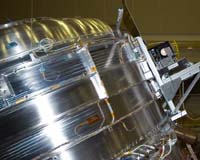
Paris, France (ESA) Oct 24, 2006 Between Tuesday, 16 October 2006 and Saturday, 21 October 2006 an engineering radiated susceptibility test and a straylight verification test have been performed at the ESTEC test centre in the frame of the Herschel PLM STM2 programme. The Herschel flight cryostat was equipped with a mechanical thermal dummy of PACS (Photodetector Array Camera and Spectrometer) FPU (Focal Plane Unit), and the cryogenic qualification models of HIFI (Heterodyne Instrument for Far Infrared) FPU and SPIRE (Spectral and Photometric Imaging Receiver) FPU. The cryostat was mated to a Service Module (SVM) mock-up. On the mock-up, one panel simulator was installed, which houses three warm SPIRE units (DPU, FCU, DCU) required to operate the SPIRE instrument during the tests. No other instrument unit was present on the SVM, since SPIRE was the only instrument operated during the tests. SPIRE received the power from the satellite EGSE (Electrical Ground Support Equipment), but commanding and telemetry was done directly via the SPIRE instrument EGSE. The objective of the engineering radiated susceptibility test was to further investigate an E-field susceptibility of SPIRE initially found during the EQM campaign in 2005 at Astrium, Ottobrunn in Germany. During last week's test at ESTEC, the cryostat has been exposed to E-field radiation in the frequency range 20-80 MHz. A large amount of scientific data was produced which needs to be analysed in detail to fully understand the results and arrive at a final conclusion. The straylight test has been performed to determine if the measurements with SPIRE are not disturbed by straylight, in particular by straylight entering the cryostat via the HIFI LOU window. To this end the HIFI LOU window was illuminated by a hot black body source. During additional measurements, the thermal shield temperatures and the cryocover mirror temperatures were varied to analyse the impact on the scientific performance of SPIRE. Initial results indicate that the straylight level measured by SPIRE is negligible. Community Email This Article Comment On This Article Related Links Mission Home The latest information about the Commercial Satellite Industry Space Technology News - Applications and Research
 Harris Corporation Achieves Uplink To Milstar Satellite
 Melbourne FL (SPX) Oct 23, 2006
Harris has reported that it is the first company to successfully uplink to a Milstar satellite using an Advanced Extremely High Frequency (AEHF) Navy Multiband Terminal prototype system. This milestone follows the company's announcement last month that it was the first to acquire and track low- and medium-data-rate waveforms on Milstar 6 using the same prototype terminal. |
|
|

| The content herein, unless otherwise known to be public domain, are Copyright 1995-2006 - SpaceDaily.AFP and UPI Wire Stories are copyright Agence France-Presse and United Press International. ESA PortalReports are copyright European Space Agency. All NASA sourced material is public domain. Additionalcopyrights may apply in whole or part to other bona fide parties. Advertising does not imply endorsement,agreement or approval of any opinions, statements or information provided by SpaceDaily on any Web page published or hosted by SpaceDaily. Privacy Statement |