|
 |
 |
 |
 |
 |
 |
 |
 |

 |
Gulf Bay Double Whammy: Rising Seas, Dammed Rivers
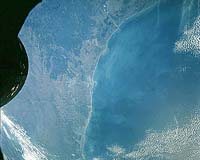
Philadelphia (SPX) Oct 24, 2006 New research finds that every U.S Gulf Coast bay in Texas and Louisiana is vulnerable to significant flooding and expansion within the coming century due to a combination of rising seas and reduced silt flowing from dammed up rivers. "Looking back over the past 10,000 years, we find the evolution of each of these bays is punctuated by rapid flooding events that result in landward shifts in bay environments of tens of kilometers and increases in bay area up to 30 percent within a century or two," said John Anderson, the W. Maurice Ewing Chair in Oceanography and professor of earth science at Rice University in Houston. "These flooding events can be triggered by either a rapid increase in sea level or a rapid decrease in the amount of silt flowing into the bay, and there's ample evidence to suggest that both of those will occur in each of these bays during the coming century." Anderson will present his findings today at the Geological Society of America's 118th annual meeting at the Pennsylvania Convention Center in Philadelphia. Anderson's results are based on his research group's analysis of dozens of sediment core samples drilled during the past decade from Galveston, Corpus Christi and Matagorda bays, all in Texas; Calcasieu Lake in Louisiana; and Sabine Lake, which straddles the Texas-Louisiana border. "Over the past 10,000 years, there are an average of a half-dozen of these flooding events in each bay," Anderson said. "They don't correlate with any global increase in sea level, and they happen at different times in different bays, so we're confident that the driving factor in these events is a decrease in the amount of river-borne sediment flowing into the bay." In the past century, multiple dams were constructed on each of the rivers flowing into each of these bays. Anderson said there is ample evidence that the dams have reduced the amount of sediments flowing from the rivers into the bays. In addition, there is a growing body of evidence that sea level will increase more rapidly in the 21st Century than it has in several thousand years. Based on marine sedimentary records, oceanographers know that sea level has been rising for the past 10,000 years, but the rate at which it's rising has been slowly falling for about 5,000 years. But that trend is apparently changing, with the latest satellite data indicating that seas worldwide are rising at an average rate of five millimeters per year � a striking contrast to the rate of two millimeters per year that was recorded by tide gauges throughout most of the 20th Century. In some locations, warming water temperatures, land subsidence and other factors can exert a local influence, causing sea level to rise even faster. This also appears to be the case along the Texas-Louisiana coast, which is sinking by an average of two millimeters per year, and up to twice that much in certain areas. "Bay-head deltas are just like the wetlands that have been disappearing in southeastern Louisiana in recent decades," Anderson said. "They have to be renewed with river-borne sediments in order to maintain themselves in the face of steadily rising seas." Anderson said the geological record shows that sediment flowing into the five bays has tended to just keep pace with rising sea level over the past 10,000 years. The flooding events mark points in time when this delicate balance was upset. The most dramatic event occurred in Galveston Bay between 7,300-7,100 years ago. In that geological instant, the boundary between river and bay receded about 35 kilometers upstream. "At that time, the head of the bay was somewhere north of I-10, but sediments flowing back into the bay from the Trinity River pushed that back south to the present location, creating Lake Anahuac in the process," Anderson said. "The creation of Lake Livingston and other lakes on the Upper Trinity has significantly reduced the amount of sediments flow into the bay, and data collected by the Texas Bureau of Economic Geology and the United States Geological Survey indicate that the headland marshes are teetering on the brink." Community Email This Article Comment On This Article Related Links Rice University Learn about Climate Science at TerraDaily.com Climate Science News - Modeling, Mitigation Adaptation
 Australia Unveils 500-Million-Dollar Climate Change Drive
 Sydney (AFP) Oct 23, 2006
Australia is to launch a 500-million-dollar drive to tackle global warming, Prime Minister John Howard announced Monday, as the country battles its worst drought in more than a century. It comes as his government, which like the United States has refused to sign the Kyoto Protocol on climate change, scrambles to contain the political impact of the effects of the protracted drought on Australia's farming community. |
|
|

| The content herein, unless otherwise known to be public domain, are Copyright 1995-2006 - SpaceDaily.AFP and UPI Wire Stories are copyright Agence France-Presse and United Press International. ESA PortalReports are copyright European Space Agency. All NASA sourced material is public domain. Additionalcopyrights may apply in whole or part to other bona fide parties. Advertising does not imply endorsement,agreement or approval of any opinions, statements or information provided by SpaceDaily on any Web page published or hosted by SpaceDaily. Privacy Statement |