
 |
 |
 |
 |
 |
 |
 |
 |
 |

 |
Green Coffee-Growing Practices Buffer Climate-Change Impacts
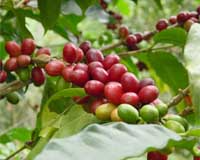
Ann Arbor MI (SPX) Oct 02, 2008 Chalk up another environmental benefit for shade-grown Latin American coffee: University of Michigan researchers say the technique will provide a buffer against the ravages of climate change in the coming decades. Over the last three decades, many Latin American coffee farmers have abandoned traditional shade-growing techniques, in which the plants are grown beneath a diverse canopy of trees. In an effort to increase production, much of the acreage has been converted to "sun coffee," which involves thinning or removing the canopy. Shade-grown farms boost biodiversity by providing a haven for birds and other animals. They also require far less synthetic fertilizer, pesticides and herbicides than sun-coffee plantations. In the October edition of the journal BioScience, three U-M researchers say shade-growing also shields coffee plants during extreme weather events, such as droughts and severe storms. Climate models predict that extreme weather events will become increasingly common in the coming decades, as the levels of heat-trapping carbon dioxide gas continue to mount. The U-M scientists warn Latin American farmers of the risks tied to "coffee-intensification programs"---a package of technologies that includes the thinning of canopies and the use of high-yield coffee strains that grow best in direct sunlight---and urge them to consider the greener alternative: shade-grown coffee. "This is a warning against the continuation of this trend toward more intensive systems," said Ivette Perfecto of the U-M School of Natural Resources and Environment, one of the authors. "Shaded coffee is ideal because it will buffer the system from climate change while protecting biodiversity." Perfecto has studied biodiversity in Latin American coffee plantations for 20 years. The lead author of the BioScience paper is Brenda Lin, whose 2006 U-M doctoral dissertation examined microclimate variability under different shade conditions at Mexican coffee plantations. Lin is currently a Science and Technology Policy Fellow with the American Association for the Advancement of Science in Washington, D.C. The other author of the BioScience paper is John Vandermeer of the U-M Department of Ecology and Evolutionary Biology. The livelihoods of more than 100 million people worldwide are tied to coffee production. In Latin America, most coffee farms lack irrigation---relying solely on rainwater---which makes them especially vulnerable to drought and heat waves. Shade trees help dampen the effects of drought and heat waves by maintaining a cool, moist microclimate beneath the canopy. The optimal temperature range for growing common Arabica coffee is 64 to 70 degrees Fahrenheit. Shade trees also act as windbreaks during storms and help reduce runoff and erosion. Lin's work in southern Mexico showed that shady farms have greater water availability than sunny farms, due in part to lower evaporation rates from the coffee plants and soils. More shade also reduced peak temperatures between 10 a.m. and 2 p.m., when southern Mexican coffee plants experience the greatest heat stress. "These two trends---increasing agricultural intensification and the trend toward more frequent extreme-weather events---will work in concert to increase farmer vulnerability," Lin said. "We should take advantage of the services the ecosystems naturally provide, and use them to protect farmers' livelihoods." Community Email This Article Comment On This Article Share This Article With Planet Earth
Related Links University of Michigan Farming Today - Suppliers and Technology
 China's Hu demands action as milk tests find melamine
 Beijing (AFP) Oct 1, 2008
Chinese authorities said Wednesday tests had found traces in nearly 12 percent of milk powder products of an industrial chemical that has so far sickened 53,000 children, killing four. |
|
|

| The content herein, unless otherwise known to be public domain, are Copyright 1995-2007 - SpaceDaily.AFP and UPI Wire Stories are copyright Agence France-Presse and United Press International. ESA Portal Reports are copyright European Space Agency. All NASA sourced material is public domain. Additional copyrights may apply in whole or part to other bona fide parties. Advertising does not imply endorsement,agreement or approval of any opinions, statements or information provided by SpaceDaily on any Web page published or hosted by SpaceDaily. Privacy Statement |
 del.icio.us
 Digg
Digg Reddit
 YahooMyWeb
 Google
 Facebook