|
 |
 |
 |
 |
 |
 |
 |
 |

 |
Global Warming Surpassed Natural Cycles In 2005 Hurricane Season
Boulder CO (SPX) Jun 26, 2006 Global warming accounted for around half of the extra hurricane-fueling warmth in the waters of the tropical North Atlantic in 2005, while natural cycles were only a minor factor, according to a new analysis by Kevin Trenberth and Dennis Shea of the National Center for Atmospheric Research (NCAR). The study will appear in the June 27 issue of Geophysical Research Letters, published by the American Geophysical Union. "The global warming influence provides a new background level that increases the risk of future enhancements in hurricane activity," Trenberth says. The research was supported by the National Science Foundation, NCAR's primary sponsor. The study contradicts recent claims that natural cycles are responsible for the upturn in Atlantic hurricane activity since 1995. It also adds support to the premise that hurricane seasons will become more active as global temperatures rise. Last year produced a record 28 tropical storms and hurricanes in the Atlantic. Hurricanes Katrina, Rita, and Wilma all reached Category 5 strength. Trenberth and Shea's research focuses on an increase in ocean temperatures. During much of last year's hurricane season, sea-surface temperatures across the tropical Atlantic between 10 and 20 degrees north, which is where many Atlantic hurricanes originate, were a record 1.7 degrees F above the 1901-1970 average. While researchers agree that the warming waters fueled hurricane intensity, they have been uncertain whether Atlantic waters have heated up because of a natural, decades-long cycle, or because of global warming. By analyzing worldwide data on sea-surface temperatures (SSTs) since the early 20th century, Trenberth and Shea were able to calculate the causes of the increased temperatures in the tropical North Atlantic. Their calculations show that global warming explained about 0.8 degrees F of this rise. Aftereffects from the 2004-05 El Nino accounted for about 0.4 degrees F. The Atlantic multidecadal oscillation (AMO), a 60-to-80-year natural cycle in SSTs, explained less than 0.2 degrees F of the rise, according to Trenberth. The remainder is due to year-to-year variability in temperatures. Previous studies have attributed the warming and cooling patterns of North Atlantic ocean temperatures in the 20th century�and associated hurricane activity�to the AMO. But Trenberth, suspecting that global warming was also playing a role, looked beyond the Atlantic to temperature patterns throughout Earth's tropical and midlatitude waters. He subtracted the global trend from the irregular Atlantic temperatures�in effect, separating global warming from the Atlantic natural cycle. The results show that the AMO is actually much weaker now than it was in the 1950s, when Atlantic hurricanes were also quite active. However, the AMO did contribute to the lull in hurricane activity from about 1970 to 1990 in the Atlantic. Global warming does not guarantee that each year will set records for hurricanes, according to Trenberth. He notes that last year's activity was related to very favorable upper-level winds as well as the extremely warm SSTs. Each year will bring ups and downs in tropical Atlantic SSTs due to natural variations, such as the presence or absence of El Nino, says Trenberth. However, he adds, the long-term ocean warming should raise the baseline of hurricane activity. Community Email This Article Comment On This Article Related Links National Center for Atmospheric Research Bringing Order To A World Of Disasters When the Earth Quakes A world of storm and tempest
 NASA Finds Intense Lightning Activity Around A Hurricane Eye
 Huntsville AL (SPX) Jun 26, 2006
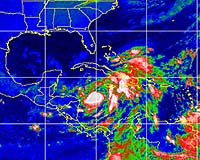
When you think of lightning, you think of a thunderstorm. Many people also assume that hurricanes have a lot of lightning because they are made up of hundreds of thunderstorms. |
|
|

| The content herein, unless otherwise known to be public domain, are Copyright 1995-2006 - SpaceDaily.AFP and UPI Wire Stories are copyright Agence France-Presse and United Press International. ESA PortalReports are copyright European Space Agency. All NASA sourced material is public domain. Additionalcopyrights may apply in whole or part to other bona fide parties. Advertising does not imply endorsement,agreement or approval of any opinions, statements or information provided by SpaceDaily on any Web page published or hosted by SpaceDaily. Privacy Statement |