|
 |
 |
 |
 |
 |
 |
 |
 |

 |
NASA Finds Intense Lightning Activity Around A Hurricane Eye
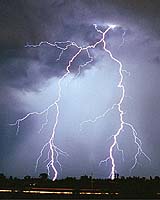
Huntsville AL (SPX) Jun 26, 2006 When you think of lightning, you think of a thunderstorm. Many people also assume that hurricanes have a lot of lightning because they are made up of hundreds of thunderstorms. However, according to Dr. Richard Blakeslee of the NASA Marshall Space Flight Center (MSFC) in Huntsville, Ala., "Generally there's not a lot of lightning in the hurricane eye-wall region. So when people detect a lot of lightning in a hurricane, they perk up -- they say, okay, something's happening." In 2005, scientists did perk up, because a very strong Hurricane Emily had some of the most lightning activity ever seen in a hurricane. Scientists are now trying to determine if the frequency of lightning is connected to the hurricane's strength. In July of that year, NASA lightning researchers joined hurricane specialists from the National Oceanic and Atmospheric Administration (NOAA) and 10 universities for a month-long Tropical Cloud Systems and Processes (TCSP) field experiment in Costa Rica. The purpose of the mission was to determine what weather, climate and other factors that helped create tropical storms and hurricanes. They also wanted to learn about what makes these storms strengthen. All of these organizations study lightning in hurricanes to get a better understanding of the strengthening or weakening (intensification) of the storms. Hurricane Emily was one of three named storms (the others were Hurricane Dennis and Tropical Storm Gert) observed during the TCSP field experiment. Scientists flew NASA's ER-2 high-altitude weather plane above Emily, where they recorded some of the most powerful lightning activity ever seen in a hurricane�s eye-wall. Emily was one of the largest, most violent hurricanes ever to be documented by the ER-2 plane. During the flights, scientists detected both cloud-to-ground lightning strokes and cloud-to-cloud lightning in the thunderstorms surrounding Emily's eye. They also found that the "electric fields," or areas of the atmosphere that contained electricity above Hurricane Emily, were some the strongest ever recorded. "We observed steady fields in excess of 8 kilovolts (8,000 volts) per meter (3.2 feet)," says Blakeslee. "That is huge�and comparable to the strongest fields we would expect to find over a large land-based thunderstorm." The field experiment concluded before the birth of hurricanes Katrina and Rita in 2005. However, scientists also observed significant lightning in the eye walls of hurricanes Katrina and Rita through long range ground-based lightning detection networks. That similarity has generated more interest in trying to understand the connection between lightning activity and hurricane development, intensification and behavior. Researchers at the National Space Science and Technology Center, a facility jointly managed and operated by NASA MSFC and Alabama research universities, are working with the NOAA to better understand the connection between lightning and hurricane intensity. The month of June is typically known among meteorologists for promoting lightning safety awareness, because June is the first month of summer and brings thunderstorms. Community Email This Article Comment On This Article Related Links NASA Marshall Space Flight Center Information About Lightning Safety NSSTC Lightning Studies Bringing Order To A World Of Disasters When the Earth Quakes A world of storm and tempest
 Flood Toll Hits 198 As Rescue Efforts Continue In Indonesia
 Sinjai, Indonesia (AFP) Jun 22, 2006
The death toll after floods and landslides in Indonesia's South Sulawesi hit 198 Thursday as workers trawled through mud and scoured nearby islands for more bodies and survivors. |
|
|

| The content herein, unless otherwise known to be public domain, are Copyright 1995-2006 - SpaceDaily.AFP and UPI Wire Stories are copyright Agence France-Presse and United Press International. ESA PortalReports are copyright European Space Agency. All NASA sourced material is public domain. Additionalcopyrights may apply in whole or part to other bona fide parties. Advertising does not imply endorsement,agreement or approval of any opinions, statements or information provided by SpaceDaily on any Web page published or hosted by SpaceDaily. Privacy Statement |