|
 |
 |
 |
 |
 |
 |
 |
 |

 |
Geologists Discover Origin Of Mysterious Black Diamonds
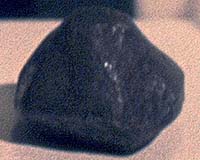
Upton NY (SPX) Jan 15, 2007 If indeed "a diamond is forever," the most primitive origins of Earth's so-called black diamonds were in deep, universal time, geologists have discovered. Black diamonds came from none other than interstellar space. In a paper published online on December 20, 2006, in the journal Astrophysical Journal Letters, scientists Jozsef Garai and Stephen Haggerty of Florida International University, along with Case Western Reserve University researchers Sandeep Rekhi and Mark Chance, claim an extraterrestrial origin for the unique black diamonds, also called carbonado diamonds. Infrared synchrotron radiation at Brookhaven National Laboratory was used to discover the diamonds' source. "Trace elements critical to an 'ET' origin are nitrogen and hydrogen," said Haggerty. The presence of hydrogen in the carbonado diamonds indicates an origin in a hydrogen-rich interstellar space, he and colleagues believe. The term carbonado was coined by the Portuguese in Brazil in the mid-18th century; it's derived from its visual similarity to porous charcoal. Black diamonds are found only in Brazil and the Central African Republic. "Conventional diamonds are mined from explosive volcanic rocks [kimberlites] that transport them from depths in excess of 100 kilometers to the Earth's surface in a very short amount of time," said Sonia Esperanca, program director in the National Science Foundation's Division of Earth Sciences, which funded the research. "This process preserves the unique crystal structure that makes diamonds the hardest natural material known." From Australia to Siberia, from China to India, the geological settings of conventional diamonds are virtually identical, said Haggerty. None of them are compatible with the formation of black diamonds. Approximately 600 tons of conventional diamonds have been mined, traded, polished and adorned since 1900. "But not a single black/carbonado diamond has been discovered in the world's mining fields," Haggerty said. The new data support earlier research by Haggerty showing that carbonado diamonds formed in stellar supernovae explosions. Black diamonds were once the size of asteroids, a kilometer or more in diameter when they first landed on Earth. Community Email This Article Comment On This Article Related Links Brookhaven National Laboratory Case Western Reserve University The Iron and Ice Of Our Solar System Carbon Worlds - where graphite, diamond, amorphous, fullerenes meet
 Resilient Form Of Plant Carbon Gives New Meaning To Term 'Older Than Dirt'
 Seattle WA (SPX) Nov 27, 2006
A particularly resilient type of carbon from the first plants to regrow after the last ice age - and that same type of carbon from all the plants since - appears to have been accumulating for 11,000 years in the forests of British Columbia, Canada. It's as if the carbon, which comes from the waxy material plants generate to protect their foliage from sun and weather, has been going into a bank account where only deposits are being made and virtually no withdrawals. |
|
|

| The content herein, unless otherwise known to be public domain, are Copyright 1995-2006 - SpaceDaily.AFP and UPI Wire Stories are copyright Agence France-Presse and United Press International. ESA PortalReports are copyright European Space Agency. All NASA sourced material is public domain. Additionalcopyrights may apply in whole or part to other bona fide parties. Advertising does not imply endorsement,agreement or approval of any opinions, statements or information provided by SpaceDaily on any Web page published or hosted by SpaceDaily. Privacy Statement |